Best Places to Visit in Aberdeenshire

Written by UK Hidden Gems Editorial
Updated 5 August 2026
The best places to visit in Aberdeenshire are Rattray Head Lighthouse, Pitsligo Castle, Hell's Lum, Burn O'Vat, Balmedie Beach, Castle of Pittulie, Dunnottar Castle and Dess Waterfall.
Aberdeenshire runs from a long, wild North Sea coast up into the wooded valley of Deeside, and its finest places mix castles, cliffs, beaches and strange corners of rock. The great set piece is Dunnottar Castle, spread in ruins across a near-severed headland on the cliffs south of Stonehaven, where the Scottish crown jewels were once hidden from Cromwell.
Along the northern coast, Rattray Head Lighthouse rises offshore from a wild sandy beach near Peterhead, and the sea has torn a chasm called Hell's Lum through the headland at Cullykhan Bay. Near Rosehearty stand the linked ruins of Pitsligo Castle and the Castle of Pittulie, and to the south the huge dunes of Balmedie Beach run for miles north of Aberdeen.
Inland on Deeside, the Burn O'Vat hides a giant rock cauldron scooped by ice-age meltwater, and Dess Waterfall drops quietly in its wooded glen. From clifftop ruins to hidden potholes, here are eight places to visit across Aberdeenshire.
Rattray Head Lighthouse
Photo: James T M Towill via Geograph.org.uk
Rattray Head Lighthouse stands offshore on a granite reef just off a long, wild, sandy beach on the Aberdeenshire coast, north of Peterhead. Built in 1895 by the Stevenson family of engineers, the white tower rises from the rock and can be reached on foot across the sand only at low tide, over a bank that the sea covers as it rises.
The beach behind it runs for miles, backed by high dunes and often near-empty, with the timbers of old wrecks sometimes showing in the sand. The light has been automatic since the 1980s, and the spot is a favourite with photographers.
Pitsligo Castle
Photo: Bill Harrison via Geograph.org.uk
Pitsligo Castle is a ruined courtyard castle in the Aberdeenshire countryside just east of Rosehearty, near the coast. Only the lowest vaulted storey of its old tower house survives, along with a better-kept stair tower, the courtyard walls, an arched gateway and carved heraldic stones, set beside a walled garden.
Built in the fifteenth century and much added to by the Forbes family, it was the seat of the Lords Forbes of Pitsligo. The last of them backed the Jacobite risings, and after the defeat at Culloden the estate was seized and the castle left to fall into ruin.
It is a free, open site kept by a local trust.
Hell's Lum
Photo: Alan O'Dowd via Geograph.org.uk
Hell's Lum is a collapsed sea cave on the Aberdeenshire coast at Cullykhan Bay, near Pennan, where the roof of a tunnel through the headland has fallen in to leave a gaping hole. The sea surges in and out of the chasm far below, and the name, meaning hell's chimney, comes from the spray and noise.
A steep path from a car park leads to the bay and the feature, with unfenced drops near the opening. Swimming here is really in the sheltered sandy bay beside it rather than the chasm itself.
Burn O'Vat
Photo: Alan Findlay via Geograph.org.uk
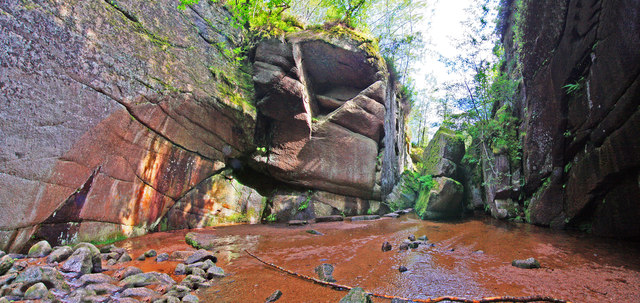
The Burn O'Vat, often just called the Vat, is a huge rounded rock cauldron hidden in the woods at Muir of Dinnet, on Deeside. It is a giant pothole, scooped out of solid rock by swirling meltwaters at the end of the last ice age, a great bowl some eighteen metres across with near-vertical walls.
To get inside you scramble over boulders and through a narrow slot in the rock, and suddenly you stand in a huge natural chamber open to the sky, with a small waterfall spilling in at the head. It sits in a nature reserve of birch woods, lochs and heath, reached by a short walk from the visitor centre.
Balmedie Beach
Photo: Richard Webb via Geograph.org.uk
Balmedie Beach is a long, wide sweep of sand on the Aberdeenshire coast, a few miles north of Aberdeen, backed by one of the largest dune systems in Britain. The sand runs for miles, with tall marram-covered dunes rising behind it and paths and boardwalks threading through them from the country park.
It is a big, open, breezy beach where you can walk a long way and see few people. Among the dunes and along the sand lie the concrete remains of wartime defences, anti-tank blocks and pillboxes left from the 1940s.
The North Sea rolls in grey and cold along the whole length.
Castle of Pittulie
Photo: Anne Burgess via Geograph.org.uk
The Castle of Pittulie is a roofless laird's house standing in farmland near Rosehearty in Aberdeenshire. Built in the late 1500s, it is an oblong two-storey block with a square tower at one corner and small turrets on the gables.
Carved armorial panels, a pediment over the doorway and a pair of oriel windows still show in the weathered stone. Its near neighbour is the ruin of Pitsligo Castle, a short way off.
Dunnottar Castle
Photo: Anne Burgess via Geograph.org.uk
Dunnottar Castle spreads in ruins across a flat-topped rock almost cut off from the land, on the cliffs a couple of miles south of Stonehaven. A steep path drops and climbs again to reach the headland, where the buildings stand ringed by sheer drops to the sea.
It was here that the Scottish crown jewels were hidden from Cromwell's army during a long siege, and smuggled out to safety. The spread of ruins and the cliff setting make it one of Scotland's most striking castles.
Dess Waterfall
Photo: Stanley Howe via Geograph.org.uk
Dess Waterfall is a small fall on the Dess Burn on Deeside, a couple of miles west of Kincardine O'Neil in Aberdeenshire. It sits in an enclosed, rocky, wooded setting, valued for its surroundings rather than its size.
A tiny layby and a short, unsigned path with a flight of steps lead down to the foot of the fall. It is a quiet, easily missed spot open at any time.
FAQs
What can you see at Dunnottar Castle near Stonehaven?
Dunnottar Castle, spread in ruins across a flat-topped rock almost cut off from the land on the cliffs south of Stonehaven, is the great sight of Aberdeenshire. It was here that the Scottish crown jewels were hidden from Cromwell's army during a long siege, and its cliff setting makes it one of Scotland's most striking castles.
How was the Burn O'Vat on Deeside formed?
The Burn O'Vat, on Deeside at Muir of Dinnet, is a huge rounded rock cauldron, a giant pothole some eighteen metres across scooped out by swirling meltwaters at the end of the last ice age. You scramble through a narrow slot to stand inside a chamber open to the sky, with a small waterfall spilling in, reached by a short walk from the visitor centre.
Are there good beaches in Aberdeenshire?
Balmedie Beach, a few miles north of Aberdeen, is a long, wide sweep of sand backed by one of the largest dune systems in Britain, with boardwalks through the dunes and wartime defences among them. The wild sandy beach behind Rattray Head Lighthouse near Peterhead also runs for miles.
Conclusion
Aberdeenshire rewards anyone who works along its coast and up into Deeside. Dunnottar Castle is the great sight, ruined across its near-severed clifftop rock south of Stonehaven, once the hiding place of the Scottish crown jewels.
Along the northern shore, Rattray Head Lighthouse rises offshore from its wild beach, the sea roars through the chasm of Hell's Lum at Cullykhan, and the linked ruins of Pitsligo and Pittulie stand near Rosehearty, while the dunes of Balmedie run for miles north of Aberdeen. Inland, the Burn O'Vat hides its giant ice-age cauldron in the Deeside woods and Dess Waterfall drops quietly in its glen.
From clifftop castles to hidden potholes and long empty sands, these are the places to seek out across Aberdeenshire.