Best Hidden Gems in Antrim & the Causeway Coast

Written by UK Hidden Gems Editorial
Updated 5 August 2026
The best hidden gems in Antrim & the Causeway Coast are Shepherd's Steps, Dooey's Cairn, Mussenden Temple, Ardclinis Church, Layd Old Church, Garvagh Pyramid, Madman’s Window and Fair Head.
The Causeway Coast and the glens of Antrim draw crowds to their best-known sights, but the shoreline and hills hide plenty more for those who look. Beyond the great basalt columns lie steep stairways, ancient tombs, clifftop follies and old churches steeped in story.
Shepherd's Steps drops down the cliffs beside the Giant's Causeway, while Mussenden Temple perches on the very edge of a cliff above Downhill Strand. Inland and along the coast road you can find the Neolithic court tomb at Dooey's Cairn, the broken-walled ruin of Ardclinis Church above Red Bay, and Layd Old Church tucked in a coastal valley near Cushendall.
There are curiosities too, from the Garvagh Pyramid hidden in a forest to the rocky gap known as Madman's Window, and grand natural drama at Fair Head, one of the largest cliff faces in Ireland. Some ask for a steep or rough walk, so come ready.
Here are eight of the best hidden gems to seek out in Antrim & the Causeway Coast.
Shepherd's Steps
Photo: David Robinson via Geograph.org.uk
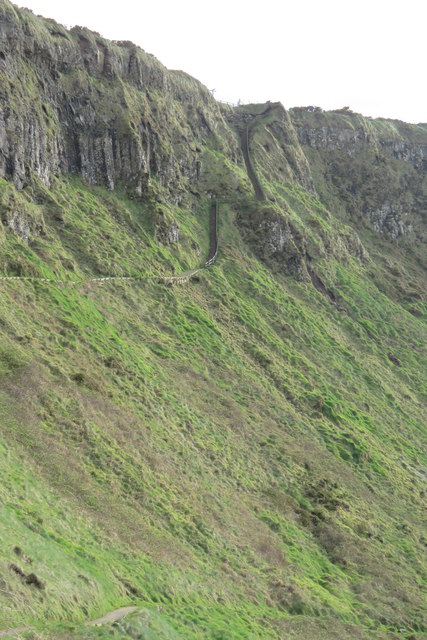
Shepherd's Steps is a steep stone stairway that climbs the cliffs on the Giant's Causeway coast in County Antrim, linking the clifftop path down to the shore below near the great basalt columns. Once a rough track used by shepherds, it is now a formal flight of some hundred and sixty steps with a handrail, a strenuous shortcut that lets walkers make a circuit taking in both the high cliff path and the Causeway itself.
The steps are uneven and the descent demanding, with wide views over the coast on the way down. Save them for a dry day and take the climb steadily.
Dooey's Cairn
Photo: Paul O'Brien via Geograph.org.uk
Dooey's Cairn is a Neolithic tomb near Dunloy in County Antrim, one of the better-preserved court tombs in the area. A U-shaped forecourt of standing stones opens into a small roofless burial chamber, with a stone-lined cremation passage behind it that is unusual for its kind in Ireland.
Excavations found the burnt remains of several people, along with stone axes and pottery. The site sits open in the fields, cared for by the state, so it is free to wander among the stones.
Seek it out for a quiet encounter with the island's deep past.
Mussenden Temple
Photo: Gerald McKenna via Geograph.org.uk
Mussenden Temple is a small round, domed building perched on the edge of a cliff high above Downhill Strand near Castlerock in County Londonderry. It stands within the Downhill Demesne, the estate of the eighteenth-century Earl Bishop of Derry, alongside the ruins of his great house, and is now cared for by the National Trust.
Modelled on a classical Roman temple, it was built in the mid-1780s as a library and named for the bishop's cousin Frideswide Mussenden. The demesne is open through the year for clifftop walks and wide views along the coast toward Donegal.
Come for the setting as much as the building itself.
Ardclinis Church
Photo: Mike Faherty via Geograph.org.uk
Ardclinis Church is a ruin on a slope above the Antrim Coast Road, between Carnlough and Waterfoot, looking out over Red Bay. Little of the church itself remains beyond low, broken walls, and the old graveyard around it is uneven ground where many headstones have fallen or sunk half into the earth.
Among the graves stands an old hawthorn, a so-called fairy tree, hung with rags and small tokens left by visitors. The site is reached from a lay-by on the coast road, a short way up the slope.
A church has stood here since at least the early fourteenth century, and it once held the Ardclinis Crozier, now kept in Dublin. Climb the slope for a haunting, story-laden spot.
Layd Old Church
Photo: N Chadwick via Geograph.org.uk
Layd Old Church is a roofless stone ruin set in a steep coastal valley about a mile north of Cushendall in County Antrim. Built of local red sandstone, the church sits in a graveyard that is still in use, on a slope looking down to the sea.
It has long been tied to the MacDonnell clan, one of whose burial places this was, and their coat of arms can be seen near the entrance. A coastal cliff path leads out to it from Cushendall, and a small road and car park bring you close, with a short walk down to the ruins.
Take the cliff path for the finest approach.
Garvagh Pyramid
Photo: Richard Webb via Geograph.org.uk
Garvagh Pyramid is a stone folly in the shape of a pyramid, hidden in the forest near Garvagh in County Londonderry. It was built in the 1800s by the local Lord Garvagh, said to have been inspired by a tour of Egypt, and meant as his burial vault, though he was never laid to rest in it.
Sealed shut, it stands empty on a raised platform, known locally as the Vault. A short waymarked forest trail from the car park leads to it, so it makes an easy woodland walk to an unexpected sight.
Follow the trail into the trees to find this curious folly.
Madman’s Window
Photo: Richard Webb via Geograph.org.uk
Madman’s Window is a gap in a rocky outcrop on the Antrim coast, about a mile east of Glenarm village, framing a view across the sea toward Scotland. A small roadside pull-in with picnic tables sits beside the coast road, and a very short walk with a little scrambling over rock brings you to the window.
The name comes from a local tale of a young man who lost his reason after his sweetheart drowned, and who came back day after day to gaze out through the gap for her return. Pull in for a quick stop and a poignant story.
Fair Head
Photo: Jonathan Wilkins via Geograph.org.uk
Fair Head is a great cliff of dark dolerite rising above the sea near Ballycastle on the north Antrim coast, one of the largest cliff faces in Ireland. The rock stands in tall columns, drawing rock climbers to some of the hardest routes in the country.
On the plateau above lie small loughs, one of them, Lough na Cranagh, holding an ancient island dwelling called a crannog. From the top the view reaches Rathlin Island and across the sea to Scotland.
Walk out to the headland for the views, keeping well back from the cliff edge.
FAQs
Which Antrim hidden gems involve a steep or difficult walk?
Shepherd's Steps is a strenuous flight of around a hundred and sixty uneven steps, and Fair Head involves a walk to high, unguarded cliffs. Ardclinis Church and Layd Old Church each need a short climb or walk from the road.
Are any of these sites free to visit?
Yes, several are. Dooey's Cairn sits open in the fields, cared for by the state, and the roadside spots at Madman's Window and Ardclinis Church are free to reach. Mussenden Temple stands within the National Trust's Downhill Demesne.
Where is Mussenden Temple?
Mussenden Temple sits on the edge of a cliff high above Downhill Strand near Castlerock in County Londonderry. It stands within the Downhill Demesne, once the estate of the eighteenth-century Earl Bishop of Derry, and is now cared for by the National Trust.
Conclusion
This corner of the north coast rewards anyone who steps away from the busiest viewpoints. In a short drive you can move from the steep descent of Shepherd's Steps to the clifftop drama of Mussenden Temple, then on to a Neolithic tomb at Dooey's Cairn or a story-soaked ruin like Ardclinis and Layd Old Church.
Curiosities like the Garvagh Pyramid and Madman's Window add a lighter touch, while Fair Head offers grand, wild scenery for those with a head for heights. Several of these places involve steep steps, rough paths or cliff edges, so wear sturdy footwear, mind your footing and go in fair weather.
Take your time, treat each site with respect and leave it as you found it, because these are the best hidden gems to seek out in Antrim & the Causeway Coast.