Best Beaches Near London

Written by UK Hidden Gems Editorial
Updated 5 August 2026
The best beaches near London are Folly House Beach, Rainbow Beach, Sheerness Beach, Westcliff Beach, Egypt Bay Beach, Northfleet Beach, Joyce Green Beach and The Frensham Beach.
London has no coast of its own, but the Thames runs right through it and out to a wide estuary, and the seaside towns of Kent and Essex and even an inland sandy lake all lie within reach. Along the river itself are the tidal foreshores that surface as the water falls: the mudlarking strand of Folly House Beach on the Isle of Dogs, and, downstream toward the estuary, the post-industrial shores at Northfleet and Joyce Green and the sea-glass shingle of Rainbow Beach near Stanford-le-Hope.
Out where the river widens are proper seaside beaches: the Blue Flag town sands of Sheerness on the Isle of Sheppey and the promenade shore at Westcliff in Southend. Wilder still is the marsh-backed Egypt Bay on the Hoo Peninsula, deep in Dickens country.
And for a swim away from the tide, the inland sands of Frensham Great Pond lie on the Surrey heaths. Some are riverside walks, others a run to the sea.
Here are eight beaches to seek out near London.
Folly House Beach
Photo: David Anstiss via Geograph.org.uk
Folly House Beach Twice a day the falling Thames uncovers this small patch of foreshore at Cubitt Town, on the eastern shoulder of the Isle of Dogs, and twice a day the water swallows it again. When it shows, a compact run of sand, shingle and river-worn debris opens below the wall near Folly Wall, good for mudlarking and for the view over to the Greenwich Peninsula and the O2.
The name reaches back to the old Folly House, an eighteenth-century riverside building that later became a tavern, its memory now carried only by the street called Folly Wall.
Rainbow Beach
Photo: Trevor Harris via Geograph.org.uk
Rainbow Beach is an informal name for a stretch of Thames estuary foreshore in Essex, near Stanford-le-Hope, on the edge of a riverside nature park. It sits on the site of an old rubbish tip, and as the low mud banks wear away they release tide-worn fragments of coloured glass, pottery and china that scatter the shore, giving the beach its name and making it a spot for beachcombing and sea-glass hunting.
It is a wild, muddy, tidal riverside rather than a bathing beach, with wide views over the working Thames and no facilities.
Sheerness Beach
Photo: Chris Whippet via Geograph.org.uk
Sheerness Beach is the town beach of the resort of Sheerness, on the north coast of the Isle of Sheppey in Kent, a stretch of shingle and pebble giving way to sand and rock beyond the tide line, with timber groynes along it. A wide flat promenade and a sea wall with flood gates run behind, backed by a park with a play area and paddling pool, amusements and a seafront of shops.
It is a busy family beach, with lifeguards in the peak season and a bathing area, and it holds a Blue Flag for its water quality.
Westcliff Beach
Photo: Glyn Baker via Geograph.org.uk
Westcliff Beach is the seafront at Westcliff-on-Sea, a western district of Southend in Essex, on the north shore of the Thames Estuary. It sits between central Southend and its pier to the east and old Leigh to the west, with a wide promenade, the Western Esplanade, running behind.
The beach is sandy along the top and gives way to shingle and broad tidal mud at low water, with cafes, toilets and deckchair hire along the front, a relaxed seaside stretch away from the busiest of the Southend crowds.
Egypt Bay Beach
Photo: N Chadwick via Geograph.org.uk
Egypt Bay is a remote curve of shore on the marshes of the Hoo Peninsula in Kent, facing the Thames estuary. A little shingle and shell-sand gives way to broad tidal mud, backed by a sea wall across the flat Halstow Marshes.
It is reached only on foot across the marshes, far from any road, and is quiet birdwatching country of oystercatchers, curlews and geese. This stretch of estuary is tied to Dickens and the old tales of prison hulks and smuggling, a lonely and atmospheric spot far from anywhere.
Northfleet Beach
Photo: David Anstiss via Geograph.org.uk
Northfleet Beach is a stretch of Thames foreshore on the Kent bank of the river near Gravesend, rather than a sandy resort beach. At low tide the water pulls back to expose mud, shingle and pebbles below the old riverside, and the frontage is being rebuilt around the new housing of Ebbsfleet and its harbour village at the mouth of the little River Ebbsfleet.
It is a post-industrial riverside walk with wide views over the working Thames, where cement works and wharves once stood, rather than a place for bathing.
Joyce Green Beach
Photo: David Martin via Geograph.org.uk
Joyce Green Beach is a stretch of Thames foreshore on the Dartford Marshes in Kent, on the low, flat ground north of Dartford near the river crossing. It is a tidal shore of mud and shingle backed by marshland and the works along the riverbank, not a resort beach but a working, industrial edge of the estuary.
Walkers and beach-clean volunteers use it, following the river wall. It looks out over the wide, busy waters of the Thames, a raw riverside stretch for those who like their walks with a working river alongside.
The Frensham Beach
Photo: David Martin via Geograph.org.uk
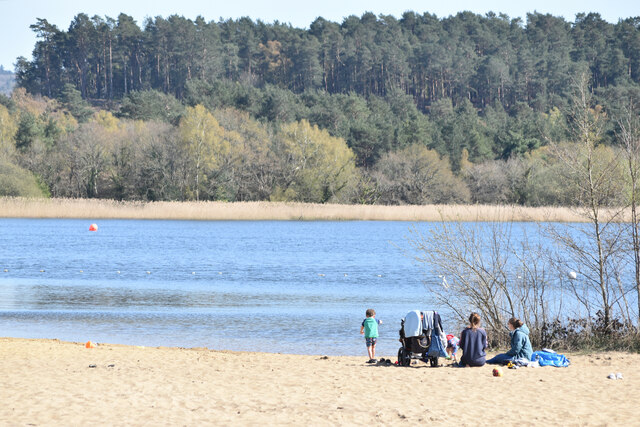
The Frensham Beach A proper sandy beach, miles from any coast, runs along one shore of Frensham Great Pond, a broad shallow lake set on heathland near Farnham in Surrey. Medieval monks dug the pond to raise fish for the bishops of Winchester, and it now sits within National Trust land and a protected common, given over to swimming in a marked area, to sailing, and to walks across the surrounding heath.
A boardwalk carries you out to the sand, with parking close by. Come summer the water occasionally closes to swimmers when blue-green algae bloom, so check before you dive in.
FAQs
Is Sheerness a good beach for a family day near London?
Sheerness on the Isle of Sheppey is a Blue Flag town beach near London, with a promenade, play area, paddling pool and seasonal lifeguards. Westcliff at Southend has a sandy top, a wide esplanade and deckchair hire. Both are a straightforward run out of London to the Thames Estuary seaside.
Which beaches near London are best for mudlarking and beachcombing?
Folly House Beach on the Isle of Dogs surfaces at low tide for mudlarking with views to the O2, and Rainbow Beach near Stanford-le-Hope scatters tide-worn glass, pottery and china across its mud from an old tip. Northfleet and Joyce Green are further foreshore walks along the working river.
Where can you actually swim near London?
Frensham Great Pond on the Surrey heaths is an inland lake with a marked swimming area and a sandy beach, a freshwater alternative to the tidal Thames near London, though it closes at times in warm spells when blue-green algae bloom. Sheerness has a proper sea bathing area with lifeguards in season.
Conclusion
London has no coast of its own, but the Thames runs out to a wide estuary, with seaside towns and even an inland sandy lake within reach. Along the river are the tidal foreshores that surface as the water falls, from the mudlarking strand of Folly House Beach to the sea-glass shingle of Rainbow Beach and the post-industrial shores at Northfleet and Joyce Green.
Out where the river widens are the Blue Flag town sands of Sheerness and the promenade shore at Westcliff in Southend, with the lonely marsh-backed Egypt Bay in Dickens country beyond. For a swim away from the tide, the inland sands of Frensham Great Pond lie on the Surrey heaths.
From a mudlarking strand to a heathland lake, these are the beaches to seek out near London.