Best Places to Visit in Perthshire

Written by UK Hidden Gems Editorial
Updated 5 August 2026
The best places to visit in Perthshire are Loch Faskally, Falls of Barvick, Pinecone View Point, Melville Monument, Black Castle Ruins, Falls of Tarf, Tomnadashan Mine and Falls of Turret.
Perthshire packs lochs, waterfalls, hills and quiet ruins into some of the most wooded country in Scotland, and this selection gathers eight of its finest for a day out. You could wander the tree-lined shore of Loch Faskally with its salmon ladder, or climb through the forest to Pinecone View Point for wide views over the Tay valley.
Waterfall lovers are spoilt, with the hidden cascades of the Falls of Barvick and the Falls of Turret above one town, and the remote, hard-won Falls of Tarf far up a Highland glen. History and mystery come with the hilltop Melville Monument, the sombre Black Castle Ruins and the dark tunnel of Tomnadashan Mine, once a film location.
Some are gentle, accessible strolls, others ask for a long walk or a steep, unmarked scramble, so choose to suit your day. Whether you want water, woodland, viewpoints or ruins, there is plenty here.
Here are eight places to visit across Perthshire.
Loch Faskally
Photo: Trevor Littlewood via Geograph.org.uk
Loch Faskally is a wooded loch just north-west of Pitlochry in Perthshire, made in the late 1940s and early 1950s when the River Tummel was dammed for hydro power. Paths run along the loch and river, taking in a town circuit, and the water is used for boating, canoeing and fishing.
The dam at its lower end has a visitor centre with windows onto the turbines and a fish ladder of thirty-four stepped pools, up which thousands of salmon climb each year, watched from an underwater chamber. Despite being man-made, it is a calm, tree-lined spot.
Seek it out for an easy loch-side walk and the salmon ladder.
Falls of Barvick
Photo: Alan Howes via Geograph.org.uk
Falls of Barvick are a series of falls on the Barvick Burn a couple of miles north of Crieff in Perthshire, on the minor road toward Loch Turret. A short circuit follows both banks of the burn on rough, steep paths, joined by a footbridge at the top.
Thick vegetation screens much of the water, so the falls are best seen after heavy rain and when the growth is low. It is a quiet, little-visited spot in the hills above the town.
Seek it out after wet weather for the fullest flow, and wear sturdy footwear for the steep paths.
Pinecone View Point
Photo: Karl Peet via Geograph.org.uk
Pinecone View Point is a hillside viewpoint in Craigvinean Forest just west of Dunkeld in Perthshire, centred on a large hand-carved wooden sculpture shaped like a pine cone. Benches around it look out across the Tay valley toward Dunkeld and the hills beyond, and the forest, one of the oldest managed woods in Scotland, is home to red squirrels and roe deer.
It was built in 2013 as part of a scheme celebrating the big trees of the area, reached by an accessible path of about three-quarters of a mile from a car park, gentle enough for wheelchairs and mobility scooters. Seek it out for an easy walk to a fine viewpoint.
Melville Monument
Photo: Richard Webb via Geograph.org.uk
Melville Monument is a tall stone obelisk on the wooded summit of Dun More, the hill rising straight above the village of Comrie in Perthshire. It was put up in 1812 in honour of Henry Dundas, Viscount Melville, a powerful Scottish politician whose role in delaying the abolition of slavery makes him a controversial figure now.
Waymarked woodland paths climb to it, often joined with the walk to the nearby Deil's Cauldron gorge, the last pull to the top short but steep. From the summit a view indicator points out the Ochil Hills, a glimpse of Loch Earn and the peaks of Ben Vorlich and Stuc a' Chroin.
Seek it out for a rewarding short climb and a big view.
Black Castle Ruins
Photo: Jim Barton via Geograph.org.uk
Black Castle Ruins is a ruined medieval stronghold in the village of Moulin, just above Pitlochry in highland Perthshire. It was built long ago on a small island in a loch, reached only by a causeway, though the loch was drained centuries later and the castle now sits on dry, boggy ground.
What remains is fragmentary: one corner tower standing fairly tall, with lengths of broken, grass-topped wall around it, the stone weathered and dark. Local tradition links its abandonment, around 1500, to an outbreak of plague, when the place is said to have been burned to contain the disease.
It stands quietly among the houses of Moulin, easily reached on foot. Seek it out for an atmospheric old ruin.
Falls of Tarf
Photo: Alan Reid via Geograph.org.uk
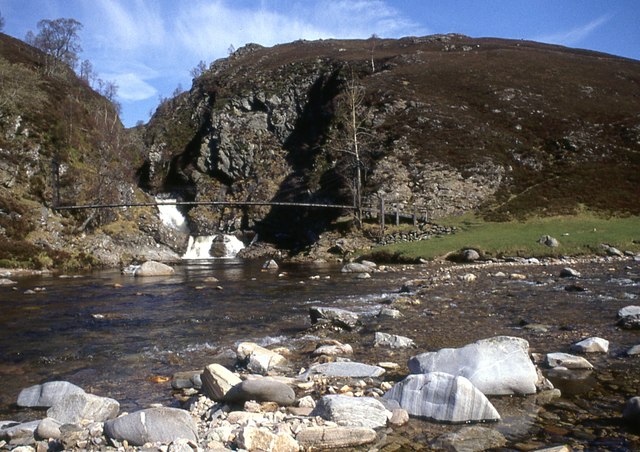
Falls of Tarf You earn this one: the falls lie some eleven miles up Glen Tilt, deep in the hills north of Blair Atholl, on the old right of way that carries walkers through to Braemar. The Tarf Water crashes through a steep ravine here, spanned at its foot by the Bedford Memorial Bridge, a slender suspension footbridge flung across in 1886 to remember a young man drowned while fording the river.
There are no roads and no shortcuts, only a long walk into remote country, which is exactly what keeps this corner of Perthshire so quiet.
Tomnadashan Mine
Photo: Richard Webb via Geograph.org.uk
Tomnadashan Mine is a disused Victorian mine on the south side of Loch Tay in Perthshire, a tunnel driven into the hillside in the mid-nineteenth century in a failed search for copper. It is best known to film fans as the Cave of Caerbannog, the lair of the killer rabbit in Monty Python and the Holy Grail, filmed here in the 1970s.
A steep, unmarked climb of about ten minutes from the single-track lochside road leads to the rocky entrance, with a tree growing from it, and a short dark tunnel that dead-ends inside. There is no lighting and no signposting, and the old working is a rough and hazardous spot.
Seek it out with care and a torch.
Falls of Turret
Photo: Sarah Charlesworth via Geograph.org.uk
Falls of Turret are a waterfall on the Turret Burn in Glen Turret, a couple of miles north-west of Crieff in Perthshire. The burn drops through a secluded, wooded gorge, once a popular Victorian spot with a bridge, a bench and a rock-cut grotto, now largely overlooked.
The final descent to the burn is steep and faint. The distillery and reservoir of Glen Turret lie further up the glen above the falls.
Seek it out for a quiet, overgrown corner of Victorian Perthshire, and take care on the steep drop to the water.
FAQs
Which Perthshire spots are easiest to reach?
Pinecone View Point is the most accessible, on a gentle path of about three-quarters of a mile that suits wheelchairs and mobility scooters. Loch Faskally also has easy loch-side paths, while the Falls of Tarf and Tomnadashan Mine need long or steep walks.
Do I need good boots for the Falls of Barvick?
Yes. The Falls of Barvick are reached on rough, steep paths along both banks of the burn, so sturdy footwear helps. The falls are best seen after heavy rain and when the surrounding growth is low.
What can I see at Loch Faskally?
Loch Faskally is a calm, tree-lined loch used for boating, canoeing and fishing, with paths along the shore. At the dam there is a visitor centre and a fish ladder of thirty-four pools, where thousands of salmon climb each year.
Conclusion
Perthshire rewards anyone who ventures beyond the main roads, with wooded lochs, tumbling falls, hilltop views and quiet ruins scattered across the county. You might spend an easy morning by Loch Faskally or on the gentle path to Pinecone View Point, then chase water at the Falls of Barvick and the Falls of Turret.
For more of a challenge, the Melville Monument gives a big view for a short, steep climb, while the remote Falls of Tarf and the dark tunnel of Tomnadashan Mine ask for real effort and care. Add the sombre Black Castle Ruins and you have a route through nearly every kind of Highland scenery.
Some are accessible strolls, others long or hazardous, so plan around your group and the weather, because these are the best places to visit in Perthshire.