Best Places to Visit in Skye & Lochalsh

Written by UK Hidden Gems Editorial
Updated 5 August 2026
The best places to visit in Skye & Lochalsh are Blà Bheinn, Bride's Veil Falls, Loch Leathan Dam, Dunscaith Castle, Coral Beach, Allt Daraich, Amar River Viewpoint and Trotternish Ridge.
Skye and Lochalsh pack mountains, sea cliffs and old castles into a dramatic island coast. The great walk is the Trotternish Ridge, the long line of basalt cliffs holding the Old Man of Storr and the Quiraing, while the Munro of Bla Bheinn rises apart from the Cuillin above Loch Slapin.
Water threads the island at the slender Bride's Veil Falls below the Storr, the deep swimming pool on the Allt Daraich at Sligachan, and the reservoirs of the Storr Lochs behind Loch Leathan Dam. The coast holds the bright white Coral Beach at Claigan, the ruined stack of Dunscaith Castle on the Sleat shore, and the quiet strath view over the winding River Amar near Struan.
Beyond the honeypots, quieter corners reward those who pull off the main road. Some are serious mountain days, others easy roadside stops.
Here are eight places to visit across Skye and Lochalsh.
Blà Bheinn
Photo: David Brown via Geograph.org.uk
Bla Bheinn, or Blaven, is a mountain on the Isle of Skye that stands a little apart from the main Cuillin ridge, rising steeply above Loch Slapin. At around 929 metres it is a Munro, the only one on Skye off the main Cuillin ridge, though made of the same rough black gabbro.
The usual way up climbs from the roadside near the head of the loch, on a good path that turns to loose stone and a short scramble near the top. From the top the view is extraordinary: the whole jagged line of the Cuillin across Glen Sligachan and the sea and islands beyond.
It is a serious hill walk, rocky and steep near the top.
Bride's Veil Falls
Photo: Elliott Simpson via Geograph.org.uk
Bride’s Veil Falls A thin white ribbon of water slipping down bare rock gives this Skye fall its name, tucked below the jagged pinnacles of the Storr on the Trotternish peninsula. You can spot it from a roadside layby, and a short but steep scramble over wet, muddy ground climbs to its foot.
From there the outlook opens across Loch Leathan to the sea, the serrated crest of the Storr looming behind. It is an informal little stop rather than a marked landmark, but a lovely pause on the drive.
Heavy rain swells it; a dry spell leaves barely a trickle.
Loch Leathan Dam
Photo: Rudi Winter via Geograph.org.uk
Loch Leathan Dam holds back the main reservoir of the Storr Lochs hydro scheme, on the east side of the Trotternish peninsula on Skye, a few miles north of Portree. The scheme was built between 1950 and 1952 and gave Skye its first general supply of electricity.
From the loch, water drops to a power station on the coast at Bearreraig Bay, reached down a steep private railway of six hundred and forty-seven steps. The dam and lochs sit just off the A855 near the car park for the Old Man of Storr walk.
Loch Leathan and neighbouring Loch Fada are the two reservoirs of the scheme.
Dunscaith Castle
Photo: Alan Reid via Geograph.org.uk
Dunscaith Castle is a ruin standing on an isolated stack of rock on the Sleat coast of Skye, near Tokavaig, cut off from the land by a deep gap in the cliff. A stone bridge once spanned the gap to the gateway, and the sockets that held its drawbridge can still be seen in the walls.
Fragments of thick curtain wall and a well survive on the rock, much of it now grassed over. In legend it was the fortress of the warrior-woman Scathach, said to have trained the hero Cu Chulainn here.
Coral Beach
Photo: John Allan via Geograph.org.uk
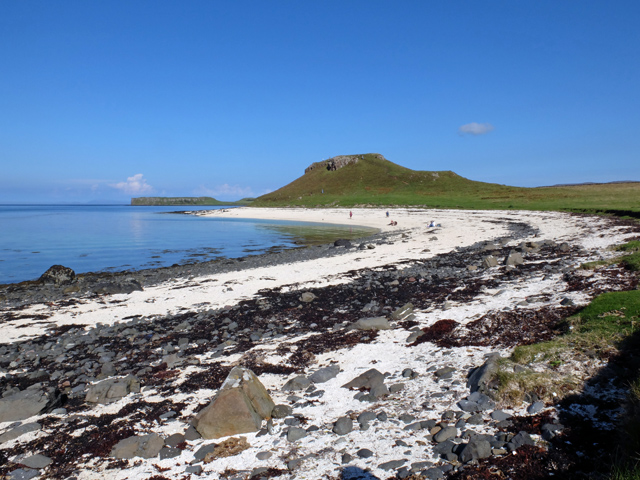
Coral Beach The dazzling white here is not coral at all but maerl, the bleached and broken remains of a hard red seaweed that washes up and dries pale in the sun. Piled along the shore at Claigan, north of Dunvegan on the Isle of Skye, it lends the bay a distinctly tropical look, and on a bright day the shallow water above it glows a clear turquoise.
Reaching it takes a mostly level walk of a couple of miles from the Claigan car park. Save the trip for sunshine, when the pale sand and bright sea play their full trick and the whole place looks as though it belongs somewhere far warmer.
Allt Daraich
Photo: Richard Dorrell via Geograph.org.uk
Allt Daraich is a burn that runs down a small rocky gorge beside Sligachan, at the northern edge of the Cuillin on Skye. A short way up it, a waterfall drops into a deep pool with a grassy bank alongside, dark and cold with peaty hill water.
Getting there takes only a few minutes on foot from the old stone bridge at Sligachan, up a path along the gorge and then down to the water. The pool is deep enough to swim in properly rather than just paddle.
All around is open moor, with the black peaks of the Cuillin and the sharp point of Sgurr nan Gillean rising behind.
Amar River Viewpoint
Photo: Richard Dorrell via Geograph.org.uk
The Amar River Viewpoint is a roadside stop on the west side of Skye, on the road between Portree and Dunvegan near Struan. From a raised layby you look down over the short River Amar as it winds through low green ground toward the sea.
The banks are grassy and rushy, the surrounding hills low and rugged, and the sea loch opens out beyond the river mouth. It is a place to pull over and take in the view rather than to walk, a quiet stretch of Highland strath with water threading through it.
Trotternish Ridge
Photo: Nigel Brown via Geograph.org.uk
The Trotternish Ridge runs north to south down the spine of the Trotternish peninsula in the north of Skye, a long line of dark basalt cliffs stretching close to twenty miles. It is the largest landslip of its kind in Britain, formed where heavy lava rock slumped over softer layers beneath.
Walkers tackle sections of it, and its two best-known features both sit on the ridge: the Old Man of Storr, a tall rock pinnacle reached by a popular short walk, and the Quiraing, a jumble of pinnacles and terraces further north. The Storr is the high point at 719 metres, and the full traverse is a long and serious mountain day.
FAQs
What is the best-known walk on Skye?
The Trotternish Ridge holds the two most-walked features on Skye: the Old Man of Storr, a tall rock pinnacle reached on a popular short walk, and the Quiraing, a jumble of pinnacles and terraces further north. The full ridge traverse, close to twenty miles of basalt cliff, is a long and serious mountain day.
Where can you swim on Skye?
The Allt Daraich at Sligachan has a waterfall dropping into a deep, cold pool, only a few minutes' walk from the old stone bridge, deep enough to swim in properly rather than just paddle. The peaty water is cold, with the black Cuillin peaks rising behind, so it suits confident cold-water swimmers.
Why is Coral Beach on Skye white?
The bright white shore at Coral Beach near Claigan on Skye is not true coral but maerl, the bleached, broken remains of a hard red seaweed that washes up and dries pale in the sun. Against it the shallow water turns a clear turquoise on a bright day, reached on a mostly level walk of a couple of miles.
Conclusion
Skye and Lochalsh pack mountains, cliffs and old castles into a dramatic coast. The Trotternish Ridge runs its long line of basalt cliffs, holding the Old Man of Storr and the Quiraing, while the Munro of Bla Bheinn rises apart from the Cuillin above Loch Slapin.
Water threads the island at the slender Bride's Veil Falls, the deep pool on the Allt Daraich at Sligachan, and the Storr Lochs behind Loch Leathan Dam. The coast holds the white Coral Beach at Claigan, the ruined stack of Dunscaith on the Sleat shore, and the quiet strath view over the River Amar near Struan.
From serious mountain day to roadside view, these are the places to seek out across Skye and Lochalsh.