Hidden Gems Near Winchester

Written by UK Hidden Gems Editorial
Updated 5 August 2026
The hidden gems near Winchester are Old Winchester Hill, The Medieval Merchant's House, God's House Tower, Bursledon Brickworks Museum, Westwood Woodland Park, Netley Abbey, Pepperbox Hill Tower and Clarendon Palace Ruins.
The cathedral city of Winchester makes a fine base for exploring the quieter corners of Hampshire and its neighbours. Head east into the Meon valley and Old Winchester Hill rises with its Iron Age fort and flower-rich downland, despite standing some miles from the city that shares its name.
Turn south toward Southampton and its old town holds a run of overlooked treasures: the Medieval Merchant's House on French Street, the gun tower of God's House, and, just beyond, the Victorian steam of Bursledon Brickworks at Swanwick. Nearer the water at Netley you can stroll the woods of Westwood Woodland Park before wandering the romantic ruins of Netley Abbey.
Look west instead, toward Salisbury in Wiltshire, and two more await: the curious Pepperbox tower on its chalk hill and the lone standing wall of Clarendon Palace, once a royal home. Some are close, others a longer drive, but all reward the trip.
Here are eight hidden gems to seek out near Winchester.
Old Winchester Hill
Photo: T Eyre via Geograph.org.uk
Climb Old Winchester Hill About eighteen kilometres east of the city, on the eastern side of the Meon valley, Old Winchester Hill rises to around 197 metres, despite its name sitting some eleven miles from Winchester itself. Its summit carries an Iron Age hillfort, with grassy banks and ditches still clear, and Bronze Age burial mounds inside and around the enclosure.
Today it is a national nature reserve of chalk grassland, rich in orchids and in butterflies such as the chalkhill and Adonis blue, with wide views over the valley. The South Downs Way crosses the top, making it an easy stop on a longer walk.
The Medieval Merchant's House
Photo: Mike Faherty via Geograph.org.uk
The Medieval Merchant's House A bomb falling in 1940 did this house an odd favour, stripping away centuries of later alterations to reveal the medieval structure beneath, which was then restored in the 1980s. Dating from about 1290, it stands on French Street in Southampton's Old Town and was raised for a wine merchant named John Fortin, complete with a vaulted wine cellar, a ground-floor shop, a central hall and upper chambers, one overhanging the street.
Copies of medieval pieces furnish the rooms to show how the place worked in its day. Run by English Heritage, it is thought to be the best-preserved house of its kind and age anywhere in England.
God's House Tower
Photo: Peter Holmes via Geograph.org.uk
God's House Tower When its gun tower went up in 1417, it was among the very first buildings in England designed to mount cannon, a heavy addition welded to a medieval gate at the south-eastern corner of Southampton's old town walls. Its later life reads like a list of civic jobs: gunpowder store, then prison, then museum, and since 2019 an arts and heritage venue run by the charity 'a space' arts.
Inside are changing exhibitions, a gallery unpicking the story of the walls, a cafe and a way up onto the roof. Listed and a scheduled monument both, it holds a corner of the Old Town.
Bursledon Brickworks Museum
Photo: Peter Facey via Geograph.org.uk
Discover Bursledon Brickworks Museum A similar distance south, at Swanwick in Hampshire, the Brickworks Museum, long known as Bursledon Brickworks, is a preserved Victorian brick factory built in 1897 and worked until 1974. Its surviving buildings, kiln, chimney and drying sheds are listed, and they still hold the original steam engine, clay machinery and continuous kiln, said to be the last steam-driven brickworks of its kind in Britain.
Run now by volunteers, it opens seasonally with working steam days, narrow-gauge railways, a heritage bus collection and a cafe. The Bursledon in its name is simply the nearest old parish; it stands on Swanwick Lane.
Westwood Woodland Park
Photo: Oast House Archive via Geograph.org.uk
Westwood Woodland Park Old gravel pits and landfill have been turned back into open grassland here, set against ancient hazel and oak woodland, with ponds, marsh and a small stream valley running through. The ground once belonged to the estate of Netley Abbey, and the reserve sits on the edge of Netley just outside Southampton.
Informal paths thread it for walking and cycling, and there are picnic areas and a car park; look out for dormice, barn owls and bluebells in spring. It opened to the public in 1986.
Worth knowing: this is not the Royal Victoria Country Park, which is a separate site down on the shore nearby.
Netley Abbey
Photo: Barry Shimmon via Geograph.org.uk
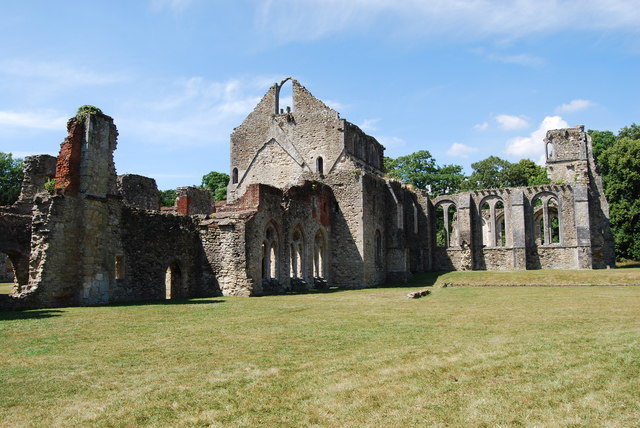
Netley Abbey Almost the entire wall of a thirteenth-century church still rises here, roofless and open to the trees, which makes this the most complete Cistercian abbey left standing in southern England. Cistercian monks founded it near Southampton in 1239; Henry VIII closed it in 1536, after which it was made over into a Tudor mansion before the years wore it down into the romantic ruin you see now, with its cloister ranges, chapter house and monks' quarters set among woodland.
English Heritage keeps it, and it is free to wander in daylight. Watch your footing, as the ground is open and uneven and the walls stand unfenced.
Pepperbox Hill Tower
Photo: Maigheach-gheal via Geograph.org.uk
Pepperbox Hill Tower Its doors and windows were sealed with brick generations ago, so the Pepperbox is a folly you admire only from the outside. Also called Eyre's Folly, this tall hexagonal brick tower rises from the chalk downland of Pepperbox Hill, a few miles southeast of Salisbury in Wiltshire, and ranks among the oldest follies in England.
The National Trust tends the hill, open grassland scattered with orchids, juniper and yew, laced with footpaths and offering long views both ways. Tradition puts the tower at 1606 and ties it to the Eyre family, though its true date and purpose stay a mystery.
Clarendon Palace Ruins
Photo: Toby via Geograph.org.uk
Clarendon Palace Ruins A single tall shard of flint-and-rubble wall is almost all that survives, the last standing end of the great hall of what was once a sprawling royal palace. English kings kept it as a country residence right through the 1100s and 1200s, and the outline of the rest lies buried in the grass around that lone fragment, waiting to be traced.
It stands in woodland and parkland a few miles east of Salisbury in Wiltshire, reached on foot through scrub and trees. A scheduled monument in quiet countryside, it is an atmospheric find for anyone who likes their history well off the beaten track.
FAQs
Why is Old Winchester Hill so far from Winchester?
Despite the name, Old Winchester Hill sits about eleven miles east of Winchester, in the Meon valley. The link is historical rather than a matter of distance, and the hill's Iron Age fort and chalk grassland make the short drive well worthwhile.
Are any of these gems free to visit?
Yes, several are. Netley Abbey near Southampton is free to enter in daylight, and Old Winchester Hill and the Pepperbox on their downs cost nothing to walk. Others, such as the Medieval Merchant's House, may charge admission.
How long a drive is Clarendon Palace from Winchester?
Clarendon Palace lies about thirty kilometres west of Winchester, just east of Salisbury, so it is the furthest of the set. It suits a longer day out combined with exploring the Wiltshire countryside.
Conclusion
Winchester's own streets are a pleasure, but the country around it hides plenty more. To the east, Old Winchester Hill offers ancient earthworks and open downland, while a run south to Southampton brings the Medieval Merchant's House, God's House Tower, Bursledon Brickworks and, near Netley, both Westwood Woodland Park and the graceful ruins of Netley Abbey.
Further west, toward Salisbury, the Pepperbox folly and the lone wall of Clarendon Palace reward a longer drive with a quiet sense of history. Whether you fancy a short hop or a proper day out, there is something here for walkers, history lovers and families alike.
Pick a clear day, plan around opening times, and these are the hidden gems to seek out near Winchester.