Best Places to Visit in Argyll & Bute

Written by UK Hidden Gems Editorial
Updated 5 August 2026
The best places to visit in Argyll & Bute are Glencoe Lochan, Mackinnon's Cave, Glen Etive, Eas Urchaidh, Castle Stalker, Pap of Glencoe, Singing Sands Beach and Corryvreckan Whirlpool.
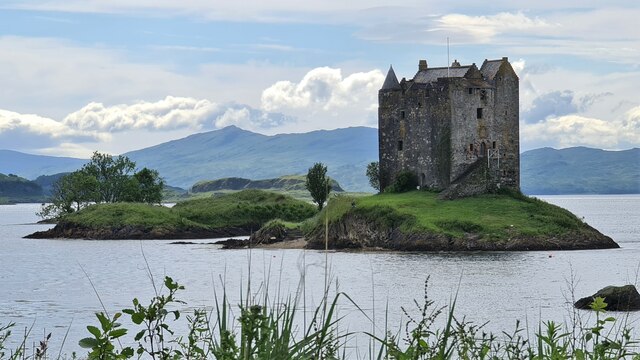
Argyll and Bute spread across sea lochs, islands and mountains at the top of the region, and their finest places run from island beaches to a roaring whirlpool. The classic view is Castle Stalker, alone on its tidal islet off the Oban road, while the Corryvreckan whirlpool churns in the gulf between Jura and Scarba, one of the largest anywhere.
At the mountainous northern edge, by the mouth of Glen Coe, the peaceful Glencoe Lochan sits in planted woodland, the Pap of Glencoe rises in its conical peak, and Glen Etive runs down its lonely single-track road to the sea. The islands hold their own gems: the long Mackinnon's Cave on Mull, reckoned the longest sea cave in the Hebrides, and the pale, squeaking Singing Sands on Islay.
Inland, Eas Urchaidh pours over its ledges in Glen Orchy. Some are easy roadside sights, others a walk or a boat trip.
Here are eight places to visit across Argyll and Bute.
Glencoe Lochan
Photo: Steven Brown via Geograph.org.uk
Glencoe Lochan is a small, man-made loch set in woodland just north of Glencoe village, ringed by easy walking trails. It was created in the 1890s by Lord Strathcona, who planted the woods with Canadian and North American trees to remind his homesick wife of Canada.
Waymarked paths loop the water and climb into the trees for views, the lochside route level enough for wheelchairs and buggies. Tall firs and other conifers rise around the still water, which mirrors the hills on a calm day.
Mackinnon's Cave
Photo: Alan Reid via Geograph.org.uk
Mackinnon's Cave is a large sea cave on the west coast of the Isle of Mull, below the cliffs near Gribun, reckoned the longest sea cave in the Hebrides at around a hundred and fifty metres. A big main chamber opens into a long, dark passage that daylight never reaches, so a torch is needed to go in.
Getting to it means a walk from Balmeanach Farm and a scramble over slippery boulders along the shore, possible only when the tide is well out. Old tales tell of a piper who went in with his dog and never came out, only the dog returning.
Glen Etive
Photo: Alan Reid via Geograph.org.uk
Glen Etive runs south-west off the head of Glen Coe, a single-track road following the River Etive down to the sea at Loch Etive. The river holds clear, cold pools that draw wild swimmers in summer, set among steep mountains.
The glen became well known as a filming spot for the James Bond film Skyfall, whose lonely road scene was shot here. It is a quiet, dead-end glen ringed by high peaks, one of the loveliest drives in the country.
Eas Urchaidh
Photo: Philip Halling via Geograph.org.uk
Eas Urchaidh Whitewater kayakers prize the River Orchy for its fast, powerful currents, and at the Falls of Orchy you can see why: the river pours over broad ledges of rock into a wooded gorge. This is Eas Urchaidh, reached along the single-track road that runs up Glen Orchy from Dalmally, with old Caledonian pines clinging to the slopes above.
A car park and picnic area sit right beside the falls, so you can settle in and take your time. Many rate it among the finest falls on the whole Orchy, an easy yet memorable place to break a Highland journey.
Castle Stalker
Photo: Chris Morgan via Geograph.org.uk
Castle Stalker is a four-storey tower house sitting alone on a small tidal islet in Loch Laich, an inlet off Loch Linnhe. Whitewashed and square, it makes the well-known view from the A828 road between Oban and Glen Coe.
The islet can be reached on foot only with difficulty at low water, and the castle is privately owned, opening on a few days in summer. It was built by the Stewarts in the 1400s and later fully restored, one of the most photographed castles in Scotland.
Pap of Glencoe
Photo: Andrew Tryon via Geograph.org.uk
The Pap of Glencoe is a distinctive conical peak rising above Loch Leven at the western end of the Aonach Eagach ridge, at the mouth of Glen Coe. Its Gaelic name, Sgorr na Ciche, means the peak of the breast, from its rounded shape, and it makes the classic view as you come into the glen.
At 742 metres it is a popular half-day climb, usually from near Glencoe village, with a rockier scramble over the last stretch to a summit that looks out over the loch, the glen and the Mamores. It is a serious outing in winter.
Singing Sands Beach
Photo: Gordon Hatton via Geograph.org.uk
Singing Sands, in Gaelic Traigh Bhan, is a crescent of pale golden sand and turquoise water on the Isle of Islay, just west of the village of Port Ellen by the Carraig Fhada lighthouse. Its name comes from the dry surface sand, which squeaks and sings underfoot when you walk across it, an effect of the fine, even grains.
It is reached by a short walk from a car park near the lighthouse, a favourite for a picnic, a swim and watching the boats into Port Ellen, with seals and otters sometimes seen. Craggy dark rock frames the sand.
Corryvreckan Whirlpool
Photo: Steve Partridge via Geograph.org.uk
The Corryvreckan whirlpool churns in the narrow gulf between the islands of Jura and Scarba, off the west coast of Scotland. As the tide floods through the strait it drives over an underwater pinnacle, throwing up standing waves, overfalls and swirling water that make it one of the largest whirlpools anywhere.
The roar can carry a long way on a big spring tide, and boats are warned to keep clear without local knowledge. It is best seen from the headlands at the north end of Jura or from boat trips run for the purpose.
FAQs
What is the Corryvreckan whirlpool in Argyll?
The Corryvreckan whirlpool is one of the largest anywhere, churning in the narrow gulf between the islands of Jura and Scarba. As the tide floods through, it drives over an underwater pinnacle to throw up standing waves and swirling water, and its roar can carry far on a big spring tide. It is best seen from northern Jura or on a boat trip.
Which castle in Argyll and Bute makes the classic view?
Castle Stalker, a four-storey tower house alone on a tidal islet in Loch Laich off the Oban road, makes one of Scotland's best-known castle views. Whitewashed and square, it was built by the Stewarts in the 1400s and later restored, and it opens to visitors on only a few days in summer.
Where can you hear the singing sands on Islay?
Singing Sands, or Traigh Bhan, on the Isle of Islay just west of Port Ellen, is a crescent of pale sand whose dry surface grains squeak and sing underfoot as you walk. It is reached by a short walk from a car park near the Carraig Fhada lighthouse, with seals and otters sometimes seen offshore.
Conclusion
Argyll and Bute range from island sands to roaring sea, and their best places range just as wide. Castle Stalker makes its classic view alone on its islet off the Oban road, and the Corryvreckan whirlpool churns in the gulf between Jura and Scarba.
At the mountainous top of the region, by the mouth of Glen Coe, the still Glencoe Lochan sits in its planted woods, the Pap rises in its cone, and Glen Etive runs lonely to the sea. The islands offer Mackinnon's Cave on Mull, longest in the Hebrides, and the squeaking Singing Sands on Islay, while Eas Urchaidh pours through Glen Orchy inland.
From roadside castle to boat-trip whirlpool, these are the places to seek out across Argyll and Bute.