Best Places to Visit in Dorset

Written by UK Hidden Gems Editorial
Updated 5 August 2026
The best places to visit in Dorset are White Nothe Beach, Stair Hole, Ringstead Radar Station, Portland Castle, Winspit Quarry, Kimmeridge Bay, Dancing Ledge and Corfe Castle.
Dorset is Jurassic Coast country, a shore of folded rock, fossils and old quarries backed by ruined castles. The great ruin is Corfe Castle, blown up in the Civil War and left leaning above its village in the Purbeck ridge, while the Tudor fan of Portland Castle guards the harbour in pale Portland stone.
The coast shows its geology at Stair Hole, where the sea is carving a new cove past the buckled Lulworth Crumple, and along the ledges of oil-shale at Kimmeridge Bay. Old quarrymen left their mark at the cliff galleries of Winspit and the flat shelf of Dancing Ledge with its blasted tidal pool.
Above it all, the wartime radar blockhouses at Ringstead and the remote undercliff beach below White Nothe reward a coast-path walk. Some are grand and busy, others take a scramble.
Here are eight places to visit across Dorset.
White Nothe Beach
Photo: Nigel Mykura via Geograph.org.uk
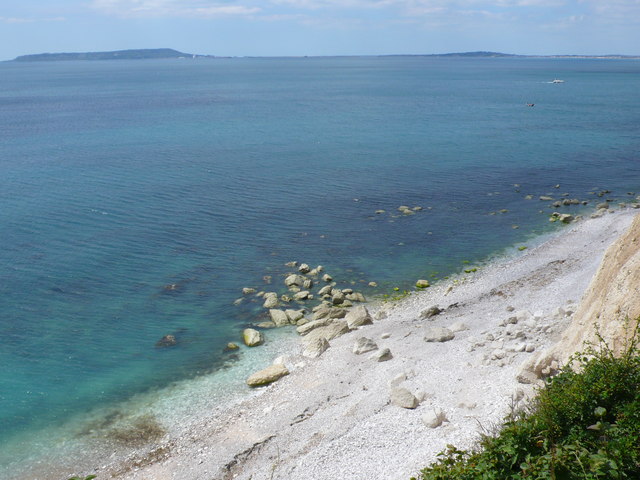
White Nothe is a high chalk headland at the eastern end of Ringstead Bay on the Dorset coast, on the Jurassic Coast between Ringstead and Durdle Door. A row of former coastguard cottages and a wartime pillbox stand on top, reached on foot along the South West Coast Path, with a steep zig-zag path known as the Smugglers' Path dropping down the cliff.
Below is a landslipped undercliff and a remote shingle and rock beach at sea level. The beach can be reached on foot along the shore from Ringstead only around low tide, and the chalk here is known for its fossils.
Stair Hole
Photo: Ian Capper via Geograph.org.uk
Stair Hole is a small, part-enclosed cove on the Jurassic Coast just west of Lulworth Cove, where the sea has broken through the hard outer rock by way of caves and arches to begin carving out a new cove. Its walls show the Lulworth Crumple, layers of limestone folded and buckled into tight waves by the movements that raised the Alps far away.
It is viewed from the coast path above, with an information panel at the spot, rather than a beach to walk onto, and shows in miniature how the neighbouring Lulworth Cove was formed.
Ringstead Radar Station
Photo: Anthony Vosper via Geograph.org.uk
Ringstead Radar Station survives as a scatter of wartime buildings on the downs above Ringstead Bay in Dorset, on National Trust land you reach along the coast path. It was a Chain Home station, one link in the string of early-warning posts that kept watch over Britain's skies, and the concrete blockhouses still standing out on the clifftop once housed the transmitter and receiver gear, though the tall masts are long gone.
It ran from 1942 to the war's end and is rated one of the best-preserved of its type in the south-west. One of its buildings is now a holiday let.
A quiet spot with a long view out to sea.
Portland Castle
Photo: Stefan Czapski via Geograph.org.uk
Portland Castle is one of the artillery forts built for Henry the Eighth, standing by the shore of Portland Harbour on the Isle of Portland. Built of pale Portland stone between 1539 and 1541 to guard the anchorage against a French invasion, it has a distinctive fan shape, a central tower behind a curved gun battery facing the sea.
It is among the best preserved of these Tudor forts, cared for by English Heritage, and visitors can go through the gun room, the Tudor kitchen and great hall and the battery, with a garden and views over the harbour. It changed hands in the Civil War and served the military into the twentieth century.
Winspit Quarry
Photo: Ian Coleby via Geograph.org.uk
Winspit is a disused coastal stone quarry at the end of a dry valley below Worth Matravers, on the Isle of Purbeck. A walk of about a mile down the valley from the village reaches galleries and caves cut horizontally into the cliff, with rock pillars left to hold up the roofs.
There is no beach; the quarry meets the sea at a rocky ledge where people swim off the rocks in calm weather, and climbers use the walls. It has appeared as a filming location for Doctor Who among others, bats roost in the sealed caves, and it sits on the South West Coast Path within the Jurassic Coast.
The National Trust has owned it since 2022.
Kimmeridge Bay
Photo: David Martin via Geograph.org.uk
Kimmeridge Bay A small nodding oil pump, one of the oldest onshore in the country, still works away on the cliff above this broad bay on Dorset's Jurassic Coast. Dark ledges of oil-bearing shale edge the water and reach out to sea, laid bare when the tide falls, and the whole bay is a marine reserve prized for rockpooling and snorkelling.
Clavell Tower, a round folly, stands on the eastern cliff, shifted back in recent years from the crumbling edge. In the village nearby, a fossil museum gathers the finds of a lifetime's patient collecting.
Time your visit for low water.
Dancing Ledge
Photo: Phil Champion via Geograph.org.uk
Dancing Ledge is a wide, flat platform of rock at the base of low cliffs on the Purbeck coast of Dorset, a leftover of old quarrying. From this deep edge stone was once lowered straight down onto boats moored alongside.
Long ago a small rectangular pool was blasted into the rock so that local schoolchildren could swim, and it still tops up with every tide. Getting there means walking the coast path, with a steep and scrambly drop down at the very end.
Wear sturdy shoes and take your time on the last stretch.
Corfe Castle
Photo: Jim Champion via Geograph.org.uk
Corfe Castle stands in ruins on a steep hill filling a gap in the Purbeck ridge, above the village that shares its name. Held for the king and defended by Lady Mary Bankes, it fell to Parliament and was blown up with gunpowder in 1646.
The blasts left towers leaning at broken angles and walls split apart, much as they stand today. The National Trust looks after the ruins, which look out over the surrounding country.
FAQs
What is the Lulworth Crumple at Stair Hole?
The Lulworth Crumple at Stair Hole is a dramatic set of folds in the rock walls, layers of limestone buckled into tight waves by the same earth movements that raised the Alps far away. Stair Hole, just west of Lulworth Cove, is where the sea is breaking through the hard outer rock to carve a new cove, viewed from the coast path above.
Which places on the Dorset coast have a swimming pool cut into the rock?
Dancing Ledge, on the Purbeck coast, has a small rectangular pool blasted into its flat rock shelf long ago for local schoolchildren, still filling with each tide. Winspit nearby has no pool but a rocky ledge where people swim off the rocks in calm weather, both reached on the coast path.
Why was Corfe Castle left in ruins?
Corfe Castle was held for the king in the Civil War and defended by Lady Mary Bankes before it fell to Parliament and was blown up with gunpowder in 1646. The blasts left its towers leaning at broken angles and its walls split apart, much as they stand today above the village in the Purbeck ridge.
Conclusion
Dorset packs its Jurassic Coast with folded rock, old quarries and ruined castles. Corfe Castle leans blown-up above its village in the Purbeck ridge, and Portland Castle guards the harbour in pale Tudor stone.
The coast shows its geology at Stair Hole, where the sea carves a new cove past the buckled Lulworth Crumple, and along the oil-shale ledges of Kimmeridge Bay. Quarrymen left the cliff galleries of Winspit and the flat shelf of Dancing Ledge with its blasted tidal pool, while the wartime radar blockhouses at Ringstead and the remote undercliff below White Nothe reward a coast-path walk.
From leaning castle to sea-cut cove, these are the places to seek out across Dorset.