Best Places to Visit in Essex

Written by UK Hidden Gems Editorial
Updated 5 August 2026
The best places to visit in Essex are Northey Island, Markshall Estate, Walden Castle, Bradwell Beach, Cressing Temple Barns, Fen Farm Beach and Prittlewell Priory.
Essex is a county of big estuary skies, ancient timber and quiet ruins, and its best places gather along the coast and in the old countryside behind it. On the Blackwater, tidal Northey Island lies out on the saltmarsh, joined to the land only by a causeway thought to be the setting of the Battle of Maldon, while the lonely chapel of St Peter-on-the-Wall stands alone by the shore at Bradwell, one of the oldest churches in England.
Timber and stone tell their own story at the great medieval barns of Cressing Temple, once granted to the Knights Templar, and at the ruined Norman keeps of Walden Castle in Saffron Walden and Prittlewell Priory in its Southend park. For gentler days there is the tree collection and lakes of the Markshall estate near Coggeshall, and the quiet foreshore of Fen Farm on Mersea Island.
Some are ancient and grand, others quiet shores. Here are seven places to visit across Essex.
Northey Island
Photo: Chris via Geograph.org.uk
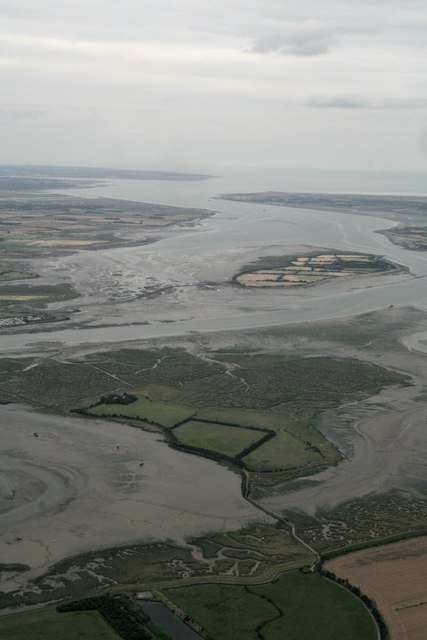
Northey Island is a low, flat tidal island in the Blackwater estuary, about a mile east of Maldon, owned by the National Trust. It is ringed by saltmarsh and mudflats and joined to the mainland only by a causeway that floods with the tide, so access is on foot at low water.
A walk of about three miles loops the island, rich in wintering and passing birds such as Brent geese, curlew and redshank, and it lies within a protected estuary. The causeway is thought to be the setting of the Battle of Maldon in 991, when a Viking army defeated the local Anglo-Saxon defenders.
Markshall Estate
Photo: Geographer via Geograph.org.uk
Markshall Estate, also known as Marks Hall Gardens and Arboretum, lies just north of Coggeshall, a two-hundred-acre arboretum set within a much larger sweep of ancient woodland and farmland. Visitors walk among a wide tree collection gathered from around the world, an eighteenth-century walled garden redesigned in modern style, a chain of lakes and woodland paths dotted with sculpture.
It is run by a charitable trust, with a plant centre and tea rooms, and there are dog-friendly woodland walks. An ancient oak on the estate is one of its best-loved trees.
Walden Castle
Photo: Oast House Archive via Geograph.org.uk
Walden Castle is the ruined keep of a Norman castle in the centre of Saffron Walden, standing beside the town museum on Museum Street. Only the flint-and-rubble core of the lower part of the square keep survives, as most of the facing stone was taken away long ago.
The grounds are free to walk at any reasonable time, with the keep itself fenced off for its own protection. It dates from the twelfth century and is linked to the de Mandeville family, though who actually built it is not known.
Bradwell Beach
Photo: Clint Mann via Geograph.org.uk
Bradwell Beach is a remote, flat stretch of the Essex coast where the land meets the sea at the mouth of the Blackwater estuary, all sea wall, saltmarsh and wide mudflats rather than sand. Its great landmark is the ancient chapel of St Peter-on-the-Wall, a bare, barn-like stone building standing alone by the shore, one of the oldest churches in England.
It was built around the year 654 by Saint Cedd, on the ruins of a Roman fort. A footpath leads out to it across the fields, and beyond, the low bulk of a decommissioned nuclear power station sits on the point.
It is a lonely, atmospheric coast of huge skies and seabirds.
Cressing Temple Barns
Photo: Robin Webster via Geograph.org.uk
Cressing Temple, near Braintree, is an old estate built around two huge medieval timber barns, the Barley Barn and the Wheat Barn. Both are among the oldest timber-framed barns in Europe, their great oak frames rising overhead like the inside of a ship.
The land was granted to the Knights Templar in 1137, and the barns went up in the century that followed. A walled Tudor garden, a tea room and open grounds complete the site.
Fen Farm Beach
Photo: Robin Webster via Geograph.org.uk
Fen Farm Beach is the quiet foreshore at the eastern end of Mersea Island, where a caravan and camping site sits a few minutes' walk from the shore. The beach fronts the mouths of the Rivers Colne and Blackwater, looking across to Brightlingsea, and it adjoins Cudmore Grove Country Park with its grassland, cafe and old wartime pillbox.
People come to walk, watch birds and launch kayaks and paddleboards at high tide, and a seasonal foot-ferry runs across to Brightlingsea from the beach.
Prittlewell Priory
Photo: terry joyce via Geograph.org.uk
Prittlewell Priory is the surviving part of a small medieval Cluniac monastery, set in Priory Park at Southend-on-Sea and now a museum. Founded in the twelfth century as a cell of Lewes Priory and closed by Henry the Eighth in 1536, most of it survives as foundations, but the refectory with its old crown-post roof, a prior's chamber and a carved Norman doorway remain.
It was given to the town and opened as Southend's first museum in 1922, and refurbished in 2012. The park around it has gardens, and an Anglo-Saxon burial ground was found nearby.
FAQs
What makes the Cressing Temple barns special?
The Barley Barn and Wheat Barn at Cressing Temple, near Braintree, are among the oldest timber-framed barns in Europe, their great oak frames rising overhead like the inside of a ship. The land was granted to the Knights Templar in 1137, and the barns went up in the century that followed, with a walled Tudor garden and tea room alongside.
How do you reach Northey Island?
Northey Island, in the Blackwater estuary about a mile east of Maldon, is joined to the mainland only by a causeway that floods with the tide, so it is reached on foot at low water. A walk of about three miles loops the island, which is rich in estuary birds, and the causeway is thought to be the setting of the Battle of Maldon in 991.
Which ancient chapel stands on the shore at Bradwell?
St Peter-on-the-Wall is the ancient chapel standing alone by the shore at Bradwell, one of the oldest churches in England. It was built around the year 654 by Saint Cedd, who came south from Lindisfarne, on the ruins of a Roman fort whose stone and brick were reused in it, and is reached on a footpath across the fields.
Conclusion
Essex gathers its best places along the estuaries and in the old country behind them. On the Blackwater, tidal Northey Island lies out on the saltmarsh by its Battle of Maldon causeway, and the lonely chapel of St Peter-on-the-Wall stands alone by the shore at Bradwell.
Ancient timber and stone survive at the great medieval barns of Cressing Temple, granted to the Knights Templar, and at the ruined keeps of Walden Castle and Prittlewell Priory in their town parks. For gentler days there are the trees and lakes of the Markshall estate near Coggeshall and the quiet foreshore of Fen Farm on Mersea Island.
From ancient barn to lonely shore, these are the places to seek out across Essex.