Best Places to Visit in Isle of Wight

Written by UK Hidden Gems Editorial
Updated 5 August 2026
The best places to visit in Isle of Wight are Carisbrooke Castle, St Catherine's Lighthouse, Luccombe Bay, The Needles and Culver Battery.
The Isle of Wight packs a great deal of chalk coast, castle history and quiet cove into a small island. The best-known sight is the Needles, three tall chalk stacks marching out from the western tip with a lighthouse on the last rock, seen from the National Trust headland and its old batteries.
History gathers at Carisbrooke Castle above Newport, where a donkey still works the treadwheel of the well house and Charles I was held before his trial. On the coast, St Catherine's Lighthouse marks the southern point near Niton, the gun emplacements of Culver Battery watch over Sandown Bay from the eastern down, and the secluded Luccombe Bay hides below its cliffs down a steep wooded chine, reached on foot or along the shore from Shanklin.
Some are grand set pieces, others quiet corners. Here are five places to visit across the Isle of Wight.
Carisbrooke Castle
Photo: Michael Garlick via Geograph.org.uk
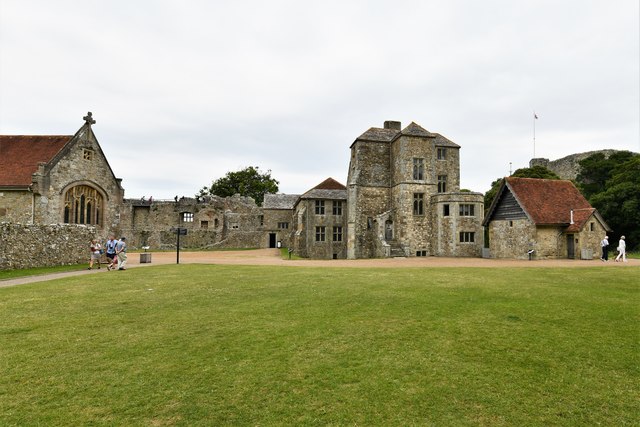
Carisbrooke Castle stands on a hill above Newport, its stone curtain walls and twin-towered gatehouse reached across a bridge over a dry moat. Inside, the best-known feature is the well house, where a donkey walks a large wooden treadwheel to draw water from a shaft that drops about 161 feet.
Grassy earthwork bastions ring the medieval walls, and you can climb them for a walk around the full circuit. Charles I was held here in 1647 and 1648 before his trial, and that stretch of his life is the castle's main story.
St Catherine's Lighthouse
Photo: Derek Harper via Geograph.org.uk
St Catherine's Lighthouse Here is a lighthouse that was made shorter on purpose. Some years after it first shone in 1840, fog kept swallowing the light on its high headland, so its keepers simply cut the tower down.
Octagonal and white, built by Trinity House at St Catherine's Point on the southern tip of the Isle of Wight near Niton, it still throws out a working beam for passing ships. The tower itself no longer opens for tours, but the old keepers' cottages beside it now take holiday guests, and the whole scene shows well from the coast paths that trace this wild reach of shore.
Luccombe Bay
Photo: John Hardy via Geograph.org.uk
Luccombe Bay is a secluded bay of sand and shingle below high sea cliffs on the south-east coast of the Isle of Wight, on the stretch between Shanklin and Ventnor. It is reached down Luccombe Chine, a steep, wooded ravine, and at low tide a strip of sand opens up between the cliff and the sea.
The only lane down is private, so most people scramble down the old landslip or walk along the shore from Shanklin. It is a quiet, often empty beach, with a cave near the chine said to have been used by smugglers, and a National Trust clifftop walk running above.
The Needles
Photo: Christine Matthews via Geograph.org.uk
The Needles At the western tip of the Isle of Wight, three tall chalk stacks stand in a line out of the sea, a lighthouse set upon the furthest rock. They are all that remains of a chalk ridge gradually gnawed away by the waves, and they take their name from a fourth, needle-shaped stack that toppled during the eighteenth century.
The red-and-white lighthouse, built in 1859, still burns its light. You can look down on them from the National Trust headland above, which still keeps its old gun batteries, join a boat trip, or ride the chairlift to the coloured sands of Alum Bay next door.
Views like these stay with you.
Culver Battery
Photo: Paul Coueslant via Geograph.org.uk
Culver Battery Perched on the open chalk down at the eastern end of the Isle of Wight, above Sandown Bay, this old battery stands on National Trust land. Two gun emplacements of brick and concrete remain, which once carried heavy coastal guns before being buried when the weapons went, then later uncovered again.
Close by on the down rises the Yarborough Monument, a tall obelisk of granite. From this high vantage the eye ranges far out over the sea and along the coast.
It is a breezy spot to take in the view and a little military history at once.
FAQs
What is the best natural landmark to see on the Isle of Wight?
The Needles are the great natural landmark of the Isle of Wight, three tall chalk stacks rising from the sea at the western tip with a lighthouse on the last rock. They are seen from the National Trust headland above, with its old gun batteries, or from boat trips and the chairlift down to the coloured sand cliffs of Alum Bay alongside.
Which places on the Isle of Wight have wartime remains?
Culver Battery and the headland above the Needles both keep wartime remains on the Isle of Wight. Culver Battery on the eastern down has two brick-and-concrete gun emplacements that once mounted heavy coastal guns, on National Trust land above Sandown Bay, and the Needles headland carries its own old gun batteries, both high viewpoints over the sea.
Is Luccombe Bay a quiet beach away from the crowds?
Yes, Luccombe Bay, between Shanklin and Ventnor, is a secluded sand-and-shingle beach below high cliffs, reached down a steep wooded chine or along the shore from Shanklin. The only lane down is private, so it stays quiet and often empty, with a smugglers' cave near the chine.
Conclusion
The Isle of Wight fits chalk coast, castle and cove into a small island. The Needles march out from the western tip with their lighthouse on the last rock, seen from the National Trust headland and its batteries.
Carisbrooke Castle keeps its well-house donkey and its story of Charles I above Newport, while St Catherine's Lighthouse marks the southern point near Niton and the guns of Culver Battery watch over Sandown Bay from the eastern down. Down a steep wooded chine, secluded Luccombe Bay hides below its cliffs.
From chalk stack to hidden cove, these are the places to seek out across the Isle of Wight.