Best Places to Visit in Orkney

Written by UK Hidden Gems Editorial
Updated 5 August 2026
The best places to visit in Orkney are RSPB Scotland Marwick Head Nature Reserve, Broch of Gurness, Waulkmill Bay, Birsay Earl's Palace and Knap of Howar.
Orkney packs ancient stone, seabird cliffs and quiet bays into a scatter of low green islands. The archaeology runs deep: the Iron Age Broch of Gurness stands ringed by its whole stone village looking across to Rousay, and the Knap of Howar on Papa Westray is a Neolithic farmstead said to be among the oldest standing buildings in northern Europe.
The sixteenth-century Earl's Palace at Birsay keeps its roofless ranges at the north-western corner of the Mainland. On the coast, the RSPB cliffs of Marwick Head crowd with nesting seabirds below the Kitchener Memorial, and the tidal sands of Waulkmill Bay draw paddlers and birdwatchers on Scapa Flow.
The islands' history runs back thousands of years, and much of it still stands in plain sight on the low, treeless land. Some are grand ancient monuments, others quiet shores.
Here are five places to visit across Orkney.
RSPB Scotland Marwick Head Nature Reserve
Photo: Jonathan Long via Geograph.org.uk
Marwick Head is a stretch of sea cliffs on the west coast of the Orkney Mainland, near Birsay, kept as an RSPB nature reserve. From the little bay at Marwick, a grassy clifftop path climbs to the top, where the sandstone cliffs are packed in spring and summer with nesting seabirds, guillemots, kittiwakes and others, wheeling and calling below.
On the summit stands the Kitchener Memorial, a tall stone tower put up in 1926 in memory of Lord Kitchener and the hundreds of men lost when the warship Hampshire struck a mine off this coast in 1916. The reserve is also a stronghold of the rare great yellow bumblebee.
Broch of Gurness
Photo: Elliott Simpson via Geograph.org.uk
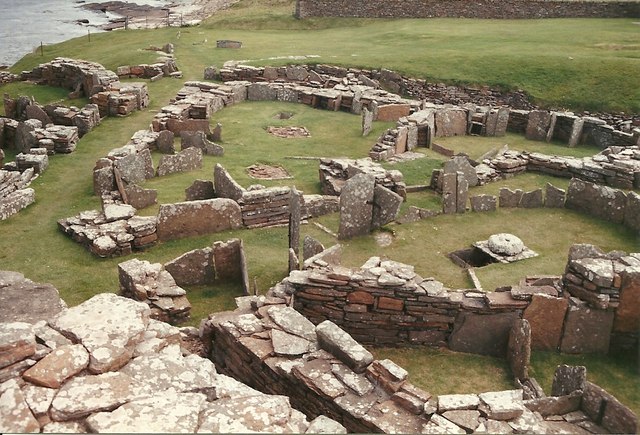
The Broch of Gurness is one of the best-preserved ancient settlements in Orkney, an Iron Age tower ringed by a whole village of stone houses, standing on a low headland looking across to the island of Rousay. At its centre is the broch itself, a massive round drystone tower that once rose perhaps ten metres high and still stands to head height and more, its interior fitted with hearths and cupboards of stone.
Around it huddle the small houses of the people who lived here more than two thousand years ago, packed along little lanes, and beyond them run deep ditches and ramparts. You can walk among the houses and into the broch.
Waulkmill Bay
Photo: N Chadwick via Geograph.org.uk
Waulkmill Bay Wait for the tide to fall and a long reach of sand emerges at the northern end, threaded with sandbars and salt marsh where fresh water spills down from the Loch of Kirbister behind. This is a tidal bay on the north shore of Scapa Flow, in the Orphir parish of Mainland Orkney, and a steep flight of steps drops to it from the car park and toilets on the road above.
Sitting beside the RSPB's Hobbister reserve, it counts as protected ground for wildlife, and its shallow, warmish water suits both waders after birds and children after a paddle. Come as the sea retreats, when the sands run widest.
Birsay Earl's Palace
Photo: Nick Mutton 01329 000000 via Geograph.org.uk
The Earl's Palace at Birsay is a ruined sixteenth-century palace standing in the village of Birsay, at the north-western corner of Orkney's Mainland. Built around a rectangular courtyard, its roofless stone ranges still rise high, with rows of empty windows and gun-holes set low in the walls to cover every approach.
You can wander freely through the open shell, the courtyard and the surviving rooms, once a grand and forbidding residence. It was built around 1570 by Robert Stewart, Earl of Orkney, a half-brother of Mary, Queen of Scots.
After his family fell from power the palace decayed. It stands near the shore, close to the tidal Brough of Birsay.
Knap of Howar
Photo: Rude Health via Geograph.org.uk
Knap of Howar Reckoned among the oldest standing buildings anywhere in northern Europe, these two stone houses on the shore of Papa Westray in Orkney are roughly five thousand years old. Their thick drystone walls still stand to head height, joined by a low passage, and inside the fittings of a Neolithic farmstead survive: stone shelves, cupboards and a hearth.
The sea laps at the very edge of the site, slowly eating into it year by year. Historic Environment Scotland looks after the place and leaves it open, so you can step straight in and stand where people lived at the dawn of settled life.
FAQs
Which are the oldest places to visit in Orkney?
The Knap of Howar on Papa Westray and the Broch of Gurness are the oldest. The Knap of Howar is two Neolithic stone houses some five thousand years old, said to be among the oldest standing buildings in northern Europe, while the Broch of Gurness on the Mainland is an Iron Age tower ringed by a whole village, lived in more than two thousand years ago. Both are open to walk into.
What can you see at Marwick Head in Orkney?
Marwick Head, an RSPB reserve on the west coast of the Mainland near Birsay, has sandstone cliffs packed with nesting guillemots, kittiwakes and others in spring and summer, reached on a grassy clifftop path. The Kitchener Memorial tower stands on the summit, and the rare great yellow bumblebee is found about.
Is there a good beach in Orkney for a gentle visit?
Waulkmill Bay, on the north shore of Scapa Flow, is the best beach for a gentle visit, uncovering a long sandy beach at low tide with a car park, toilets and steps down to the sand. Its shallow water and protected wildlife setting next to the Hobbister RSPB reserve make it popular for paddling and birdwatching.
Conclusion
Orkney fits ancient stone, seabird cliffs and quiet bays into its low green islands. The Iron Age Broch of Gurness stands ringed by its whole stone village looking across to Rousay, and the Knap of Howar on Papa Westray is a Neolithic farmstead among the oldest standing buildings in northern Europe.
The sixteenth-century Earl's Palace at Birsay keeps its roofless ranges at the Mainland's north-western corner. On the coast, the RSPB cliffs of Marwick Head crowd with seabirds below the Kitchener Memorial, and the tidal sands of Waulkmill Bay draw paddlers and birdwatchers on Scapa Flow.
From Iron Age broch to Neolithic farmstead, these are the places to seek out across Orkney.