Best Hidden Gems in Oxfordshire

Written by UK Hidden Gems Editorial
Updated 5 August 2026
The best hidden gems in Oxfordshire are The Oxford Botanic Garden’s Secret Corners, The Oxford Castle & Prison’s Underground Crypt, The Harry Potter Tree, The Rollright Stones, St Edmund Hall’s Library, Old Mans Bridge, Godstow Abbey and Devil's Quoits.
Oxfordshire is best known for the spires and colleges of Oxford, but beyond the well-trodden streets lie quieter corners that reward anyone willing to look. This is a county where the oldest botanic garden in Britain hides its tucked-away beds off the High Street, where a Neolithic stone circle sits freely open beside a country lane, and where a Norman crypt lies beneath a medieval castle on the western edge of the city.
Out in the countryside you can find the ruin of a riverside nunnery near the Thames, a plain wooden footbridge on a peaceful stretch of the young river, and an ancient cedar made popular by a film at Blenheim Palace. From the restored henge at Stanton Harcourt to a college library housed in a redundant Norman church, these places range from ticketed attractions to free and open sites, each with its own story and its own sense of discovery.
Here are eight of the best hidden gems to seek out in Oxfordshire.
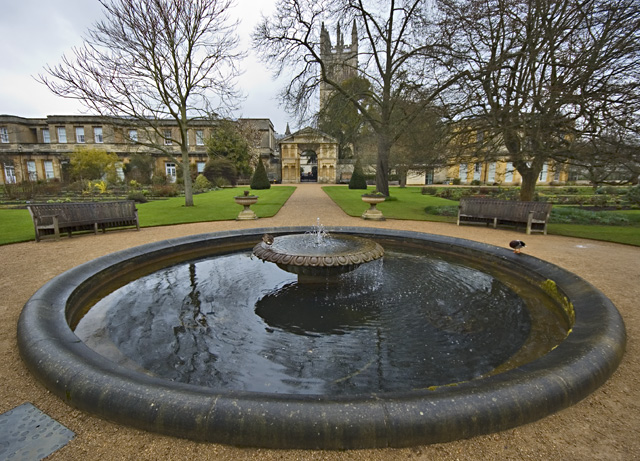
The Oxford Botanic Garden’s Secret Corners
Photo: Paul Harrop via Geograph.org.uk
The Oxford Botanic Garden’s Secret Corners lie off the High Street by Magdalen Bridge and the River Cherwell, the oldest botanic garden in Britain, founded in 1621 as a physic garden for medicinal plants. A stone gateway of the 1630s leads into the original walled garden, laid out in beds by plant family, with herbaceous borders, a collection of medicinal plants and a range of glasshouses holding tropical, arid and alpine species.
More than 5,000 kinds of plant grow here, and there is a sister arboretum a few miles south. This is a ticketed garden run by the university, so buy your ticket and take time to find its quieter, little-known corners.
The Oxford Castle & Prison’s Underground Crypt
Photo: Bill Nicholls via Geograph.org.uk
The Oxford Castle & Prison’s Underground Crypt is a part-ruined medieval castle and former jail on the western side of the city centre, opened as a visitor attraction in 2006 after the prison closed in 1996. On a guided tour led by a costumed guide, you climb St George's Tower for views over the city, go down into the crypt of the old St George's chapel and up the castle mound.
The Norman crypt dates from about 1074, with its original columns, though the fabric was rebuilt in the 18th century. Part of the old prison next door is now a hotel, so book onto a tour to reach the crypt below.
The Harry Potter Tree
Photo: Bill Boaden via Geograph.org.uk
The Harry Potter Tree is an ancient cedar of Lebanon standing on the bank of the Great Lake at Blenheim Palace, near Woodstock. A huge, gnarled tree with a great circular hollow in its lakeside face where a limb once fell away, it was planted more than two centuries ago when Capability Brown laid out the park.
It took its nickname after appearing in a Harry Potter film, and has become a popular photo stop, now fenced and cabled to protect it from the wear of visitors. It is reached on foot through the Blenheim parkland, so set out across the park to find it by the water.
The Rollright Stones
Photo: John H Darch via Geograph.org.uk
The Rollright Stones are a group of three prehistoric monuments standing on the border of Oxfordshire and Warwickshire, near Long Compton, raised over some two thousand years in the Neolithic and Bronze Age. The largest, the King's Men, is a circle of about seventy weathered limestone stones set close together.
Across the road stands a single tall stone, the King Stone, and a short way off is a huddle of stones called the Whispering Knights, the remains of an early burial chamber. By legend a king and his men were turned to stone here by a witch.
They are cared for by a trust, freely open with a small honesty box, so drop a coin in and wander among them.
St Edmund Hall’s Library
Photo: Bill Nicholls via Geograph.org.uk
St Edmund Hall’s Library is housed in the redundant Norman church of St Peter-in-the-East, on Queen's Lane. The 12th-century church stopped holding services in 1965 and reopened as the college library in 1970, its reading desks arranged within the old nave and chancel.
Beneath is a well-preserved Norman crypt of about 1130, with rows of stone columns and rounded arches. The former churchyard is now a garden with a statue of St Edmund.
The library and crypt are mainly for college members, with the crypt seen only by arrangement, so plan ahead if you hope to go below.
Old Mans Bridge
Photo: Bill Nicholls via Geograph.org.uk
Old Mans Bridge is a plain wooden footbridge carrying the Thames Path over the upper River Thames in Oxfordshire, in quiet countryside between Radcot and Rushey Lock, near the villages of Bampton and Aston. It stands on the site of an old weir, and the present bridge dates from the end of the nineteenth century.
This is a peaceful, rural stretch of the young river, popular with walkers on the long-distance path and with swimmers, with open fields on either bank and no development nearby. Follow the Thames Path out from Radcot to find this quiet crossing.
Godstow Abbey
Photo: Sarah Charlesworth via Geograph.org.uk
Godstow Abbey is the ruin of a medieval nunnery on the bank of the Thames near Wolvercote, just outside Oxford, close to the Trout Inn. Little survives above ground beyond one small two-storey building in the corner of the old cloister and lengths of the precinct wall, set in a riverside field.
It was founded in the 1130s and pulled down after the Dissolution, its converted buildings later burned in the Civil War. It is celebrated as the resting place of Fair Rosamund, mistress of Henry II, so wander the riverside field to picture the nunnery that once stood here.
Devil's Quoits
Photo: Chris Brown via Geograph.org.uk
Devil's Quoits is a Neolithic henge and stone circle at Stanton Harcourt in Oxfordshire, ringed by a bank and inner ditch. The site was almost wiped out, flattened for a wartime airfield and then dug for gravel, before being rebuilt with its circle of stones restored between 2002 and 2008.
Around two dozen conglomerate stones now stand again inside the earthwork. It sits on much-altered ground between a flooded gravel pit and a landfill site, a reminder of how completely a monument can be lost and brought back.
Come to see one of the county's boldest recent restorations.
FAQs
What are the best hidden gems in Oxfordshire?
They range from the Oxford Botanic Garden and the crypt at Oxford Castle to the Rollright Stones, Godstow Abbey and the Devil's Quoits. Some sit in the city, others out in the countryside near the Thames. Together they cover prehistoric stones, Norman crypts and riverside ruins.
Are Oxfordshire's hidden gems free to visit?
Some are. The Rollright Stones are freely open with a small honesty box, and Old Mans Bridge and Godstow Abbey can be reached on foot at no charge. Others, such as the Oxford Botanic Garden and the guided tour of Oxford Castle, are ticketed.
How do you reach the Rollright Stones?
The stones stand on the border of Oxfordshire and Warwickshire, near Long Compton. They are cared for by a trust and freely open, with a small honesty box for donations, so you can wander among the King's Men, the King Stone and the Whispering Knights.
Conclusion
From the medicinal beds of Britain's oldest botanic garden to a restored henge on much-altered ground, Oxfordshire keeps its best hidden gems well away from the tourist trail. Some, like the Oxford Botanic Garden and the underground crypt at the castle, ask for a ticket or a guided tour, while others, like the Rollright Stones and Old Mans Bridge, are free and open to anyone who makes the trip.
You can trace the county's long past through prehistoric stones, Norman crypts, ruined nunneries and ancient trees, each rewarding a little effort to reach. Whether you want a riverside walk, a quiet ruin or a place steeped in legend, there is something here for every kind of explorer, and taken together, these are the best hidden gems to seek out in Oxfordshire.