Best Places to Visit in Oxfordshire

Written by UK Hidden Gems Editorial
Updated 5 August 2026
The best places to visit in Oxfordshire are The Oxford Castle & Prison's Underground Crypt, Grand Cascade, The Column of Victory, Cheese Wharf, North Leigh Roman Villa, Buscot Weir, The Harry Potter Tree and The Turf Tavern.
Oxfordshire pairs the old city of Oxford with the great estate of Blenheim and the quiet upper Thames. In the city, the medieval Oxford Castle and Prison opens its Norman crypt and tower on guided tours, and the tucked-away Turf Tavern hides down its alley by the Bridge of Sighs.
Blenheim Palace holds several finds in its parkland: the Grand Cascade where Capability Brown dammed the Glyme, the towering Column of Victory, and the hollow old cedar known as the Harry Potter Tree. Out in the country, North Leigh Roman Villa keeps its mosaic floor by the Evenlode, and the young Thames offers gentle swimming at Cheese Wharf and Buscot Weir near Lechlade.
Blenheim, a World Heritage Site, is the great draw, but the quieter Thames-side spots reward a slower visit too. Some are grand set pieces, others quiet corners.
Here are eight places to visit across Oxfordshire.
The Oxford Castle & Prison's Underground Crypt
Photo: Bill Nicholls via Geograph.org.uk
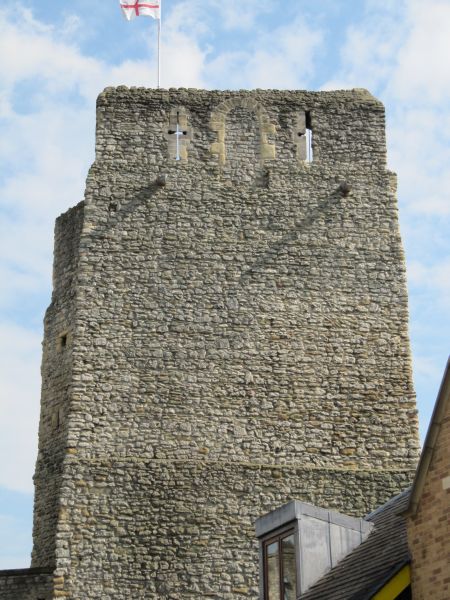
The Oxford Castle & Prison’s Underground Crypt A costumed guide sets the pace here, taking you up St George's Tower for a sweep across the rooftops, then down into the shadowy Norman crypt of the old St George's chapel, its columns standing since roughly 1074 even though the stonework above was remade in the eighteenth century. This part-ruined medieval castle and one-time jail, on the western flank of the city centre, welcomed its first visitors in 2006, a decade after the prison shut in 1996.
The tour finishes atop the grassy castle mound, and the neighbouring cell block now trades as a hotel.
Grand Cascade
Photo: Graham Hogg via Geograph.org.uk
The Grand Cascade is a waterfall at the western end of the Great Lake at Blenheim Palace, near Woodstock in Oxfordshire, where the River Glyme spills over a dam in a broad sheet of falling water. It was designed in the 1760s by Lancelot Capability Brown, who dammed the Glyme to make the lake and shaped the cascade as part of his landscaping of the park, and it has been called one of the most lovely waterfalls in England.
A major restoration in the early 2020s lowered the lake, took down and rebuilt around a hundred and fifty metres of stone walling, and uncovered original timbers from Brown's day. It is reached on foot through the Blenheim parkland.
The Column of Victory
Photo: Len Williams via Geograph.org.uk
The Column of Victory is a tall stone column standing on the great avenue in the park at Blenheim Palace, near Woodstock, raised to the first Duke of Marlborough. A fluted Doric column carries a lead statue of the duke dressed as a Roman general, holding a small figure of Victory, and its base is covered with a long inscription reciting his battles.
It was put up between 1727 and 1730 to a design by Nicholas Hawksmoor, standing some 134 feet tall, and is seen on walks through the Blenheim parkland, a landmark across the estate.
Cheese Wharf
Photo: Steve Daniels via Geograph.org.uk
Cheese Wharf is a swimming spot on the River Thames near Lechlade, on the road toward Buscot on the Oxfordshire bank. A grassy glade opens onto a deep pool on a bend of the river, with an old concrete wharf on the bank and a rope swing over the water.
The name comes from the days when cheese was loaded onto barges here to go downriver to London. It is a quiet, low-key stretch of the young Thames.
North Leigh Roman Villa
Photo: Steve Daniels via Geograph.org.uk
North Leigh Roman Villa is the remains of a large Roman courtyard villa beside the River Evenlode near Witney in Oxfordshire, a free English Heritage site set among fields. The low walls and foundations lay out the plan of a house that grew to around sixty rooms, with baths and underfloor heating, at its height in the early fourth century.
Its finest survival is a detailed mosaic floor of red and brown geometric patterns, thought to be from the dining room, kept under a shelter and open to view on staffed days through the summer. A walk of about half a mile along a track leads to the site from the roadside.
Buscot Weir
Photo: Des Blenkinsopp via Geograph.org.uk
Buscot Weir is a weir on the River Thames at the little National Trust village of Buscot, in the flat countryside of the upper Thames in Oxfordshire. The river spills over the weir into a broad, slow pool below, with grassy banks and a meadow alongside, and it has long been a favourite spot for a river swim on a warm day.
The setting is gentle and pastoral, willows and water meadows, with the old stone village close by. People come to swim, picnic and paddle in the calm water above and below the weir, and there is a car park and a tea room a short walk away.
The Harry Potter Tree
Photo: Bill Boaden via Geograph.org.uk
The Harry Potter Tree A great circular hollow marks the lakeside face of this ancient cedar of Lebanon, where a limb once fell away. It grows on the bank of the Great Lake at Blenheim Palace, near Woodstock in Oxfordshire, planted more than two centuries ago when Capability Brown laid out the park.
Huge and gnarled, it earned its nickname after appearing in a Harry Potter film and has drawn a steady stream of photographers ever since, so much so that it is now fenced and cabled against the wear of visitors. Reach it on foot across the Blenheim parkland, down by the water.
The Turf Tavern
Photo: Mr Eugene Birchall via Geograph.org.uk
The Turf Tavern is a small, tucked-away pub in central Oxford, reached down the narrow, winding St Helen's Passage between Holywell Street and New College Lane, near the Bridge of Sighs. Low-beamed and part timber-framed, it has courtyard beer gardens, one bounded by a surviving stretch of the medieval city wall, and it is popular with students and visitors.
The site is of medieval origin, though there has been a tavern here since the late eighteenth century, when it was known as the Spotted Cow. It is a listed building.
FAQs
What can you see in the parkland at Blenheim Palace in Oxfordshire?
Several finds lie in the park at Blenheim Palace near Woodstock: the Grand Cascade, where Capability Brown dammed the River Glyme into a broad sheet of falling water; the 134-foot Column of Victory raised to the first Duke of Marlborough; and the ancient hollow cedar known as the Harry Potter Tree, all reached on foot through the parkland.
Where can you swim in the Thames in Oxfordshire?
The young Thames near Lechlade offers two gentle spots: Cheese Wharf, a deep pool on a bend with a rope swing on the Oxfordshire bank, and Buscot Weir at the National Trust village of Buscot, where the river spills into a broad, slow pool with grassy banks, a car park and a tea room nearby.
Which places show Oxfordshire's history best?
Oxford Castle and Prison opens its Norman crypt of about 1074 and St George's Tower on guided tours, and North Leigh Roman Villa near Witney keeps the mosaic floor and underfloor heating of a large courtyard house by the Evenlode, a free site open on staffed days in summer.
Conclusion
Oxfordshire pairs the old city with the great estate of Blenheim and the quiet upper Thames. In Oxford, the medieval castle and prison opens its Norman crypt and tower, and the Turf Tavern hides down its alley by the Bridge of Sighs.
Blenheim holds several finds in its parkland: the Grand Cascade where Brown dammed the Glyme, the towering Column of Victory, and the hollow old Harry Potter Tree. Out in the country, North Leigh Roman Villa keeps its mosaic by the Evenlode, and the young Thames offers gentle swimming at Cheese Wharf and Buscot Weir near Lechlade.
From Norman crypt to river weir, these are the places to seek out across Oxfordshire.