Hidden Gems Near St Albans

Written by UK Hidden Gems Editorial
Updated 5 August 2026
The hidden gems near St Albans are Roman Wall of St Albans, Roman Theatre of Verulamium, Hypocaust & Roman Mosaic, Old Gorhambury House, Welwyn Roman Baths, Berkhamsted Castle, Panshanger Park and Scott's Grotto.
St Albans grew up on the site of Roman Verulamium, one of the great towns of Roman Britain, and much of its story still lies close to the centre. In Verulamium Park a long stretch of the old Roman city wall runs beside the lake, with a Roman mosaic and its underfloor heating kept under cover nearby, while across the road the grassy banks of the Roman Theatre mark one of very few true theatres known in the province.
West of the city the Elizabethan ruin of Old Gorhambury House stands in its park, once home to the philosopher Francis Bacon. Further out in Hertfordshire lie the Welwyn Roman Baths, sealed in a vault beneath the A1(M), the Norman earthworks of Berkhamsted Castle, the ancient oak and old lakes of Panshanger Park, and Scott's Grotto at Ware, a shell-lined maze of chambers dug into a chalk hill.
Some are Roman remains on the doorstep, others castles, gardens or an underground folly a short drive out. Here are eight hidden gems to seek out near St Albans.
Roman Wall of St Albans
Photo: Nigel Cox via Geograph.org.uk
Roman Wall of St Albans Through Verulamium Park on the edge of St Albans in Hertfordshire runs a long piece of the defensive wall that once encircled Roman Verulamium. Built of flint and tile in the AD 260s or thereabouts, the wall stretched some two miles around the town and stood around five metres tall; the surviving lengths still reach roughly four metres, joined by the footings of towers and a town gate.
English Heritage keeps it open in the park at no cost, an easy addition to a visit taking in the nearby Roman museum, the lake and the theatre. Follow the wall on foot and let the layers of history stack up.
Roman Theatre of Verulamium
Photo: PAUL FARMER via Geograph.org.uk
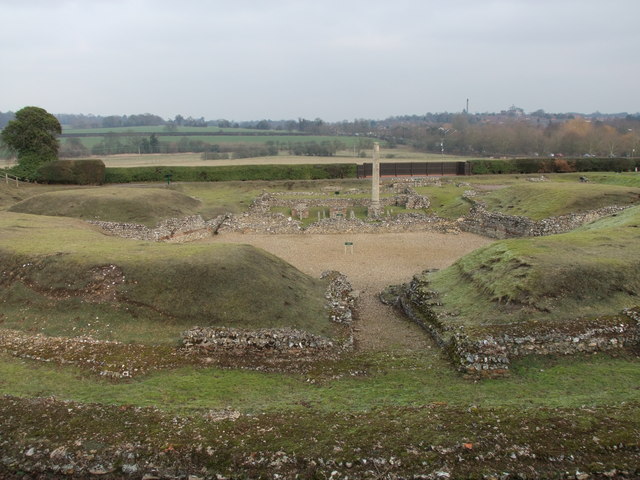
Roman Theatre of Verulamium On the western edge of St Albans, where the Roman city of Verulamium once stood, lie the dug-out remains of a Roman theatre, a genuine rarity, as few true theatres are known anywhere in Roman Britain. Wander among the grassy banks and low footings and you will spot a lone replica column marking the stage, with the outlines of a townhouse and a shrine close by.
Raised around AD 140, it was later expanded to seat several thousand before it fell out of use and ended its days as a rubbish tip. It sits on the private Gorhambury estate, open to callers for a modest charge.
Bring your imagination to fill the grassy bowl with crowds.
Hypocaust & Roman Mosaic
Photo: Nigel Cox via Geograph.org.uk
The Hypocaust & Roman Mosaic A small glass-fronted shelter in Verulamium Park protects a patterned mosaic floor and the brick-pillared heating system that once warmed it, both left in the very spot they were excavated. They come from a grand town house of around AD 200 in Roman Verulamium, the city that stood here long before St Albans.
Looking down, you can picture warm air drawing between the pillars beneath the floor. Entry is free, and the Verulamium Museum stands close by in the same park.
Old Gorhambury House
Photo: Des Blenkinsopp via Geograph.org.uk
Old Gorhambury House In parkland west of St Albans in Hertfordshire lie the ruins of Old Gorhambury House, once among the earliest of England's great Elizabethan mansions. Sir Nicholas Bacon, Lord Keeper to Elizabeth I, raised it between 1563 and 1568, reusing stone taken from the dissolved abbey at St Albans, and his son, the philosopher Francis Bacon, made it his home in later years.
Its fate was sealed when a newer house went up close by in the 1770s and the old one was abandoned to crumble. English Heritage now tends what remains, chiefly a two-storey classical porch and the stump of a clock tower, set on the private Gorhambury estate.
An atmospheric fragment of a once-grand seat.
Welwyn Roman Baths
Photo: Mr Ignavy via Geograph.org.uk
Welwyn Roman Baths Sealed within a steel vault directly under junction 6 of the A1(M) near Welwyn in Hertfordshire, the Welwyn Roman Baths are the surviving bath house of a Roman villa. A walkway tunnel drops down to the chamber, where the underfloor heating survives along with the floors of the warm, hot and cold rooms and the cold plunge bath itself.
A local archaeologist uncovered the remains in 1960, and they were preserved rather than lost when the motorway was driven across the spot. The Welwyn Hatfield Museum Service now looks after the site.
It is a curious thrill to stand among Roman brickwork with traffic thundering overhead.
Berkhamsted Castle
Photo: Graham Hogg via Geograph.org.uk
Berkhamsted Castle is the ruin of a Norman castle in the middle of the Hertfordshire town of the same name, its grassy earthworks and broken flint walls free to explore. It was one of the earliest castles raised after the Norman Conquest, and it was near here in 1066 that the English submitted to William the Conqueror after Hastings.
It grew into a great motte-and-bailey stronghold, with a high mound, a ring of walls and a double moat, later held by men including Thomas Becket and the Black Prince. You can walk the earth banks, look into the moats and trace the low walls, with the railway close alongside, a drive west of St Albans.
Panshanger Park
Photo: Julian Paren via Geograph.org.uk
Panshanger Park Filling around a thousand acres of the Mimram valley between Hertford and Welwyn Garden City, Panshanger Park opened to walkers in 2014, its land owned by a quarrying firm and looked after for nature by the county wildlife trust. Capability Brown and Humphry Repton both helped shape the grounds, though the mansion they framed was pulled down in the 1950s.
Paths wind through woodland, grassland and wetland, tracing a chalk stream and skirting old lakes, with one route laid out as a dragonfly trail. Its star turn is the Panshanger Oak, a colossal ancient tree, one of the country's finest maiden oaks, now fenced behind iron railings.
Seek out the oak and let the trails do the rest.
Scott's Grotto
Photo: Mike Quinn via Geograph.org.uk
Scott's Grotto Bored into a chalk hillside at Ware in Hertfordshire, Scott's Grotto winds through underground passages and chambers dressed with flints, shells, fossils and coloured glass, and many rate it the best example of its kind in the country. The Quaker poet John Scott created it between 1764 and 1768 as a private retreat and somewhere to receive guests.
Six chambers burrow back into the hill, the furthest sitting well beneath the summit, with shafts driven up to the surface to let in daylight. A local society now cares for it and throws open the doors on certain days.
Step inside for a hushed, faintly unearthly wander through the dark.
FAQs
Which hidden gems near St Albans are in Verulamium Park?
Three of the city's Roman remains stand together in Verulamium Park, on the edge of St Albans: a long surviving stretch of the Roman city wall beside the lake, a Roman mosaic floor and its underfloor hypocaust kept under cover, and, just across the road, the grassy banks and foundations of the Roman Theatre. All are a short walk from the Verulamium Museum.
Can you go inside the Welwyn Roman Baths near St Albans?
Yes. The Welwyn Roman Baths, a drive north-east of St Albans, are the bath house of a Roman villa preserved inside a steel vault beneath junction 6 of the A1(M). A pedestrian tunnel leads down to the chamber, where you can see the underfloor heating and the warm, hot and cold rooms with the plunge bath. Welwyn Hatfield Museum Service opens the site to visitors.
What is Scott's Grotto near St Albans?
Scott's Grotto is an eighteenth-century grotto dug into a chalk hillside at Ware, east of St Albans, often called the finest of its kind in England. The Quaker poet John Scott made it between 1764 and 1768 as a retreat, and its six flint-, shell- and glass-lined chambers run deep into the hill, lit by shafts to the surface. A local society opens it on set days.
Conclusion
St Albans wears its Roman past close to the surface, and much of it lies within a short walk of the centre. In Verulamium Park stand a long run of the old city wall, a Roman mosaic and hypocaust kept under cover, and the grassy banks of one of Roman Britain's few true theatres.
West of the city the Elizabethan ruin of Old Gorhambury House recalls Francis Bacon. Further out in Hertfordshire are the Welwyn Roman Baths beneath the motorway, the Norman earthworks of Berkhamsted Castle, the ancient oak and lakes of Panshanger Park, and the shell-lined chambers of Scott's Grotto at Ware.
From a Roman theatre to an underground grotto, these are the hidden gems to seek out near St Albans.