Best Places to Visit Near Weymouth

Written by UK Hidden Gems Editorial
Updated 5 August 2026
The best places to visit near Weymouth are Eweleaze Beach, Portland Castle, Ringstead Bay, Ringstead Radar Station, Church Ope Cove, Butter Rock, Stair Hole and Fossil Forest.
Weymouth curves around its wide bay on the Dorset coast, a Georgian seaside town at the heart of the Jurassic Coast. Set out from here and you soon find a run of beaches, forts and geological oddities, most of them a short hop away.
To the south, the Isle of Portland juts into the Channel, home to a Tudor artillery fort of pale Portland stone and a sheltered pebble cove reached beneath a ruined castle. Head east along the coast instead and the cliffs take over: a quiet shingle bay below the great chalk headland of White Nothe, the concrete remains of a wartime radar station on the downs above, and a private farm beach at Osmington.
Further along toward Lulworth you meet a slender white chalk stack near Bat's Head, a folded half-formed cove, and a petrified forest that lies within an army firing range. Together they mix sand, castles, cliffs, wild swimming and hidden corners of history.
Here are eight places to visit near Weymouth.
Eweleaze Beach
Photo: Jim Champion via Geograph.org.uk
Visit Eweleaze Beach A few miles east of town at Osmington, Eweleaze is a private beach tucked below Eweleaze Farm on the Jurassic Coast. A shore of stone and pebble sits at the foot of steep steps down from the clifftop, with the Isle of Portland lying out across the bay.
The farm on the land above runs a popular summer campsite, and the beach is chiefly for its guests rather than a general public spot, so it is worth knowing the score before you set off. The South West Coast Path runs along the cliff top here, giving walkers the wide sea views even when the sand below is out of reach.
Portland Castle
Photo: Stefan Czapski via Geograph.org.uk
Explore Portland Castle On the Isle of Portland to the south, this squat coastal fort was built for Henry the Eighth between 1539 and 1541 to guard the anchorage of Portland Harbour against a French invasion. Made of pale local Portland stone, it has a distinctive fan shape, a central tower rising behind a curved gun battery that faces out to sea.
It ranks among the best-preserved of these Tudor forts, and English Heritage now cares for it: visitors can explore the gun room, the Tudor kitchen and great hall and the battery, with a garden and views across the harbour. It changed hands during the Civil War and stayed in military use into the twentieth century.
Ringstead Bay
Photo: Nigel Mykura via Geograph.org.uk
Discover Ringstead Bay Between Weymouth and Lulworth, Ringstead Bay is a gently curving beach of shingle and sand set below the towering white chalk headland of White Nothe. As the tide falls it uncovers sand and rock pools over an offshore reef, and the whole place feels clearer and less crowded than the bigger resorts nearby.
It is National Trust land, with a clifftop car park, a beach cafe and the South West Coast Path running along the top toward Durdle Door. Fossil hunters comb the rocks here, and just inland lies the site of a medieval village that was abandoned after the Black Death, a poignant footnote to a lovely stretch of coast.
Ringstead Radar Station
Photo: Anthony Vosper via Geograph.org.uk
See Ringstead Radar Station On the downs just above Ringstead Bay stand the remains of a wartime radar post, set on National Trust land and reached along the coast path. This was a Chain Home station, part of the network of early-warning radar posts that watched over Britain's skies.
The tall masts have long since gone, but the concrete blockhouses that once held the transmitter and receiver equipment still survive out on the clifftop. It operated from 1942 until the end of the war and is reckoned one of the best-preserved examples of its kind in the south-west.
One of the buildings has since been converted into a holiday let.
Church Ope Cove
Photo: don cload via Geograph.org.uk
Find Church Ope Cove Back on the Isle of Portland, on its eastern side, Church Ope Cove is a sheltered pebble beach hemmed in by cliffs on three sides. The path down to it is part of the appeal, passing beneath the stone arch of the ruined Rufus Castle and by the remains of the old church of St Andrew.
A row of traditional beach huts lines the edge of the shore, adding a splash of colour. The smooth white and grey pebbles underfoot come from a mix of natural erosion and old quarry waste, a reminder of Portland's long history of stone-cutting.
It is a quiet, secluded spot away from the busier beaches.
Butter Rock
Photo: Jonathan Thacker via Geograph.org.uk
Seek out Butter Rock West of Lulworth, near the headland of Bat's Head, Butter Rock is a slim white pinnacle of chalk standing on the shore at the foot of the cliffs. It is a lone stack of bright chalk, a smaller cousin of the great arches and stacks that punctuate this stretch of coast, and it stands out sharply against the sea and the darker shore below.
Walkers and photographers on the coast path between Durdle Door and Bat's Head make a beeline for it. Reaching it means a clifftop walk with wide views over the water, but it is a small and striking reward at the end.
Stair Hole
Photo: Ian Capper via Geograph.org.uk
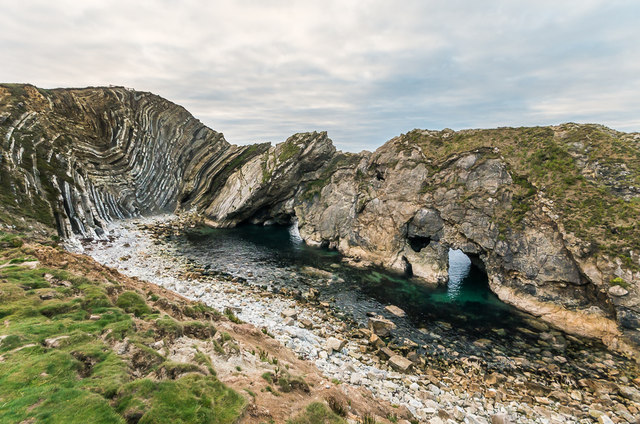
Look down on Stair Hole Just west of Lulworth Cove, Stair Hole is a small, part-enclosed cove where the sea has punched through the hard outer rock by way of caves and arches and begun to carve out a new bay behind. Its walls put on a geology lesson: the twisting bands known as the Lulworth Crumple, layers of limestone folded and buckled into tight waves by the same earth movements that raised the Alps far away.
You look down on it from the coast path above, where an information panel explains the scene, rather than walking onto a beach. In effect it shows in miniature how neighbouring Lulworth Cove itself was formed.
Fossil Forest
Photo: Julian Dowse via Geograph.org.uk
Explore the Fossil Forest Just east of Lulworth Cove, on the South West Coast Path, the Fossil Forest preserves the remains of an ancient woodland. What survives is not wood at all but stony, ring-shaped mounds that formed around the trunks of long-vanished trees once rooted beside a lagoon.
A gate and a flight of steps off the coast path drop down to the ledge where they lie. There is one catch: the whole site sits within the Lulworth army firing range, so it can only be reached when the range is open to the public.
Check the firing times before you go, and you will find one of the odder sights on this coast.
FAQs
How far is Portland Castle from Weymouth?
Portland Castle lies about five kilometres south of Weymouth, on the shore of Portland Harbour on the Isle of Portland. This well-preserved Tudor fort is looked after by English Heritage and open to visitors.
Where can you go wild swimming near Weymouth?
Ringstead Bay, east of Weymouth below White Nothe, has calm water and rock pools at low tide, while sheltered Church Ope Cove on the Isle of Portland is another quiet spot for a dip.
Do you need to check firing times for the Fossil Forest?
Yes. The Fossil Forest, just east of Lulworth Cove near Weymouth, sits inside the Lulworth army firing range, so it can only be reached on days when the range is open to the public.
Conclusion
From the Georgian seafront, the coast around Weymouth quickly opens into forts, beaches and geological curiosities. Head south to the Isle of Portland for a Tudor artillery castle in pale stone and the sheltered pebbles of Church Ope Cove beneath a ruined keep.
Turn east instead and the Jurassic Coast unfolds: the quiet sweep of Ringstead Bay below White Nothe, a wartime radar station on the downs above, and a private farm beach at Osmington. Carry on toward Lulworth for the white spire of Butter Rock, the folded rock of Stair Hole and a petrified forest tucked inside an army range.
Beaches, castles, cliffs, wild swimming and hidden history all lie within a short journey. Whether you have an afternoon or a whole day, these are the places to visit near Weymouth.