Top Hidden Gems Day Trips from Weymouth

Written by UK Hidden Gems Editorial
Updated 5 August 2026
The top Hidden Gems Day Trips from Weymouth include Ringstead Radar Station, Butter Rock, Stair Hole, Fossil Forest, Tyneham Village, Cerne Giant, The Blue Pool and Winspit Quarry.
Weymouth's golden bay is a fine base for exploring the drama of the Dorset coast, and some of its most intriguing corners lie a short way along the Jurassic Coast. Just east of town, above Ringstead Bay, the concrete remains of a wartime radar station sit on the clifftops.
Head towards Lulworth and you find the slender chalk pinnacle of Butter Rock near Bat's Head, the folded cliffs of Stair Hole, and the curious petrified stumps of the Fossil Forest. Further east into the Isle of Purbeck lie the abandoned village of Tyneham, frozen since 1943, the colour-shifting Blue Pool near Wareham, and the sea-cut galleries of Winspit Quarry above Worth Matravers.
Inland to the north, the giant chalk figure above Cerne Abbas is well worth the drive. Between them these outings take in cliffs, coves, quarries and hillside carvings, ranging from a few miles out to a longer run across Purbeck.
Whether you want a bracing coastal walk or a slower afternoon of history, there is plenty to choose from. Here are eight hidden gems for a day trip from Weymouth.
Ringstead Radar Station
Photo: Anthony Vosper via Geograph.org.uk
Ringstead Radar Station A few miles east of Weymouth, on National Trust downs above Ringstead Bay, sit the remains of a wartime radar post reached along the coast path. This was a Chain Home station, part of the chain of early-warning posts that watched Britain's skies, and the concrete blockhouses still standing out on the clifftop once held the transmitter and receiver equipment, though the tall masts are long gone.
It operated from 1942 until the end of the war and is reckoned one of the best-preserved of its kind in the south-west. One of the buildings has since been converted into a holiday let.
Butter Rock
Photo: Jonathan Thacker via Geograph.org.uk
Butter Rock West of Lulworth near the headland of Bat's Head, Butter Rock is a slim white pinnacle of chalk standing on the Jurassic Coast shore, a manageable trip from Weymouth. This lone stack of bright chalk has been left standing at the foot of the cliffs, a smaller cousin of the great arches and stacks along this stretch of coast.
The white rock stands out sharply against the sea and the darker shore, making it a favourite subject for walkers and photographers on the path between Durdle Door and Bat's Head. Reaching it means a clifftop walk, rewarded with wide views over the water.
Stair Hole
Photo: Ian Capper via Geograph.org.uk
Stair Hole Just west of Lulworth Cove, an easy trip east of Weymouth, Stair Hole is a small, part-enclosed cove where the sea has broken through the hard outer rock by way of caves and arches to begin carving out a new cove. Its walls show the celebrated Lulworth Crumple, layers of limestone folded and buckled into tight waves by the same earth movements that raised the Alps far away.
You view it from the coast path above, where an information panel explains the scene, rather than walking down to a beach. In effect it shows in miniature how neighbouring Lulworth Cove itself was formed.
Fossil Forest
Photo: Julian Dowse via Geograph.org.uk
Fossil Forest Just east of Lulworth Cove on the South West Coast Path, the Fossil Forest is a set of fossilised remains of an ancient forest, a rewarding trip east of Weymouth. What survives is not wood but stony, ring-shaped mounds that formed around the trunks of long-vanished trees rooted beside a lagoon.
A gate and a flight of steps off the coast path lead down to the ledge where they lie. One thing to plan around: the site sits within the Lulworth army firing range, so it can only be reached when the range is open.
Check the firing times before you set out.
Tyneham Village
Photo: Ian Capper via Geograph.org.uk
Tyneham Village Out in a Purbeck valley east of Weymouth, Tyneham is an abandoned village emptied of its people just before Christmas 1943, when the War Office took it over for army training and never handed it back. Around 225 residents were moved out when it was requisitioned.
It lies inside the Lulworth firing ranges, so visits are only possible when the ranges are not in use. Wander among roofless, weathered stone cottages, plus two buildings kept as exhibitions: St Mary's Church and the old schoolhouse, laid out much as it was left.
From the village a path leads down to Worbarrow Bay.
Cerne Giant
Photo: Nigel Mykura via Geograph.org.uk
Cerne Giant North of Weymouth above Cerne Abbas, the Cerne Giant is a huge chalk figure of a naked man carved into a hillside, a club raised in one hand. Standing about 180 feet tall, its outline is kept clear by cutting the turf back to the white chalk beneath, and it is best seen from the road or the viewpoint across the valley.
The National Trust has cared for it since 1920. Its age is much debated, with recent testing pointing to a far later origin than the ancient date once assumed.
It makes a memorable inland stop on a Dorset day out.
The Blue Pool
Photo: Chris Downer via Geograph.org.uk
The Blue Pool A drive east into the Isle of Purbeck, a few miles south of Wareham, brings you to the Blue Pool, a flooded old clay pit set in heath and woodland. Its water is known for changing colour, shifting from turquoise and blue-green to grey and green as fine clay particles suspended in it catch the light.
Clay was dug here for centuries for pipes and pottery. Today it is a quiet nature spot, with woodland walks around the pool, a small museum and an Art Deco tea room from the 1930s, set among heathland that shelters rare reptiles.
It is a protected site with an entry charge.
Winspit Quarry
Photo: Ian Coleby via Geograph.org.uk
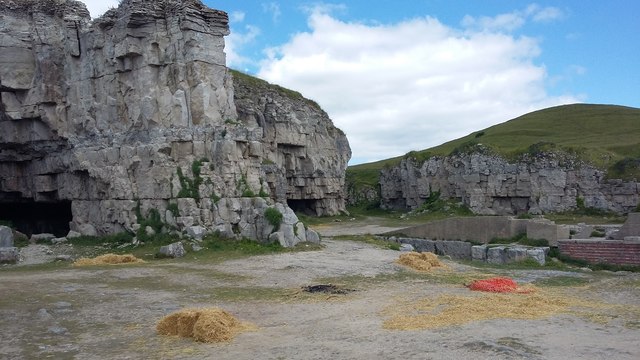
Winspit Quarry At the far end of the Isle of Purbeck below Worth Matravers, a longer drive east from Weymouth, Winspit is a disused quarry at the end of a dry valley. A walk of about a mile down the valley from the village reaches galleries and caves cut horizontally into the cliff, with rock pillars left to hold up the roofs.
There is no beach; the quarry meets the sea at a rocky ledge where people swim off the rocks in calm weather, and climbers use the walls. It has served as a filming location for Doctor Who, bats roost in its sealed caves, and it sits on the coast path within the Jurassic Coast.
FAQs
How far is the Isle of Purbeck from Weymouth?
The Purbeck gems range from about 20 kilometres for Tyneham to 30 for Winspit Quarry near Worth Matravers, so from Weymouth they are best treated as a full day out rather than a quick trip.
Which of these can I only visit at certain times?
The Fossil Forest and Tyneham village both lie within the Lulworth firing ranges near Weymouth, so they open only when firing is not taking place. Always check the range schedule first.
Are any suitable for a swim?
Winspit Quarry on the Purbeck coast has a rocky ledge where people swim off the rocks in calm weather, though there is no beach as such. For easier swimming, Weymouth's own bay is far gentler.
Conclusion
From a wartime radar post on the clifftops to an abandoned village frozen in 1943, the country around Weymouth is rich in stories as well as scenery. You could spend a morning on the coast path past Butter Rock and Stair Hole, an afternoon among the ruins of Tyneham, or a longer run out to the colour-shifting Blue Pool and the sea-carved galleries of Winspit.
Inland, the Cerne Giant rewards the drive north. A few of these sit within firing ranges, so it pays to check access before you travel, and the further Purbeck outings suit a full day rather than a quick hop.
Pack walking boots and plan around the tides and ranges. Whatever your mood, these are the hidden gems for a day trip from Weymouth.