Best Places to Visit in Cornwall

Written by UK Hidden Gems Editorial
Updated 5 August 2026
The best places to visit in Cornwall are St Mawes Castle, Gold Diggings Quarry, Piper's Hole, Kennall Vale, St Nectans Glen, Mousehole Rock Pool, Trewavas Mine and Bosahan Cove.
Cornwall packs castles, mines, hidden coves and holy waterfalls into one long peninsula. The grand set piece is St Mawes Castle, a well-preserved Tudor artillery fort guarding the Fal estuary, while the ruined engine houses of Wheal Trewavas cling to the cliff edge near Praa Sands, part of the county's mining heritage.
Water shapes the quieter corners: St Nectan's Kieve pours through a hole in the rock in its wooded glen near Tintagel, the gunpowder-works ruins of Kennall Vale moulder in a green river valley near Falmouth, and the sea cave of Piper's Hole hides its carved verse on Crantock Beach. For a swim, Gold Diggings Quarry has flooded to a deep moorland pool on Bodmin Moor, and Mousehole keeps its old tidal bathing pool, while the sheltered inlet of Bosahan Cove sits wooded on the Helford River.
Some are grand and busy, others take a walk or a scramble. Here are eight places to visit across Cornwall.
St Mawes Castle
Photo: Chris Gunns via Geograph.org.uk
St Mawes Castle stands by the shore on the Roseland peninsula, guarding the mouth of the Fal estuary opposite Pendennis Castle across the water, the two once able to cover the channel between them with their guns. Built for Henry the Eighth between 1540 and 1542 against the threat of invasion, it has a clover-leaf plan, a round central tower with three curved gun bastions, and is among the best preserved of these Tudor artillery forts.
English Heritage now cares for it, and visitors can go through the gun rooms and the tower, see its carved inscriptions and old cannon, and enjoy the gardens and estuary views.
Gold Diggings Quarry
Photo: joe bowie via Geograph.org.uk
Gold Diggings Quarry is a disused granite quarry on the open moor above Minions on Bodmin Moor, near the Cheesewring. Two of its pits have flooded to make a deep pool ringed by low cliffs, with flat slabs of quarry stone around the edge.
It is reached on foot across the moor from the car park at Minions, a walk of around twenty minutes. It has become a popular spot for wild swimming out on the high moor.
Piper's Hole
Photo: Rob Farrow via Geograph.org.uk
Piper's Hole is a sea cave set in a deep gully about two-thirds of the way along Crantock Beach, near Newquay on the north coast of Cornwall, reached across the sand at low tide. Its draw is a set of carvings cut into the rock inside: the face of a woman and a verse beginning, Mar not my face but let me be.
By local tradition they were carved in the 1920s by a grieving man after a woman was caught by the rising tide and drowned in the gully. The cave is free to reach from the National Trust car park, but the tide floods in fast, so timing matters.
Kennall Vale
Photo: Tony Atkin via Geograph.org.uk
Kennall Vale is a wooded nature reserve in a steep river valley at Ponsanooth, near Falmouth, run by the wildlife trust. Among the trees stand the mossy ruins of a nineteenth-century gunpowder works, where water from the Kennall River was led along leats to drive the mills.
Ruined buildings and a flooded quarry lie scattered through the wood, damp and green. Paths wind through the reserve, alive with birds and bats, the river running past dippers.
St Nectans Glen
Photo: Rob Purvis via Geograph.org.uk
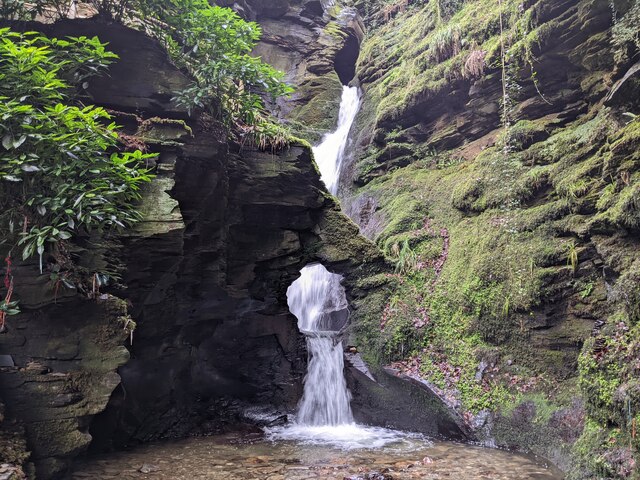
St Nectan's Glen is a wooded river valley near Tintagel, whose great feature is St Nectan's Kieve, a waterfall that pours through a round hole worn in the slate rock into a basin below. A footpath of about a mile follows the Trevillet river up through the trees from the road to the falls, which are on private land with a small entry charge and a tea room at the top.
The glen has long had a spiritual pull, tied to a sixth-century hermit saint, and visitors leave ribbons, stacked stones and other offerings among the trees and by the water.
Mousehole Rock Pool
Photo: Shaun Ferguson via Geograph.org.uk
Mousehole Rock Pool Generations of Mousehole children learned to swim in this shallow tidal pool, penned behind a low concrete wall against the rocks and refilled twice a day by the sea. It hugs the shore of this Cornish fishing village near Penzance, just below the Rock Pool Cafe at the edge of the houses.
Wade in and the view stretches clear across Mount's Bay to St Michael's Mount and, further off, the Lizard. Getting down to it means picking your way over rocks, and there is nothing in the way of facilities at the water itself, but the setting more than makes up for it.
Trewavas Mine
Photo: Chris Allen via Geograph.org.uk
Wheal Trewavas is a set of ruined mine engine houses perched on the cliff edge near Rinsey Head, between Rinsey and Praa Sands on Cornwall's south coast. Two tall stone engine houses still stand right at the top of the cliffs, their workings once running out under the seabed.
It was chiefly a copper mine, worked for a short spell in the 1830s and 1840s before it closed suddenly in 1846. The South West Coast Path passes the site, which is part of the Cornish Mining World Heritage Site, and it gives long views along the coast.
Bosahan Cove
Photo: Colin Park via Geograph.org.uk
Bosahan Cove is a small, secluded cove on the wooded south bank of the Helford River, on the Lizard side of Cornwall. It is a quiet sweep of sand and shingle backed by old trees, more like a quiet inlet on a wooded estuary than an open Cornish beach, with calm water where yachts often lie at anchor offshore.
No road comes down to it: you reach it on foot along the coast path from Helford village, through the trees, or by boat across the river. There are no facilities and it is rarely busy, just the cove, the woods and the slow water of the Helford, with the Bosahan estate gardens running down toward the shore behind.
FAQs
What kind of castle is St Mawes?
St Mawes is a Tudor artillery fort, built for Henry the Eighth between 1540 and 1542 to guard the mouth of the Fal estuary opposite Pendennis Castle. It has a clover-leaf plan, a round central tower with three curved gun bastions, and is among the best preserved of these forts, with gun rooms, carved inscriptions and old cannon to see.
Which places can you swim in Cornwall?
Gold Diggings Quarry on Bodmin Moor has flooded to a deep pool ringed by low cliffs, reached on a walk across the moor from Minions, and Mousehole keeps an old tidal bathing pool held against the rocks below the village. Both are cold, and the Mousehole pool takes a scramble over rocks to reach.
What is St Nectan's Kieve?
It is the waterfall at the heart of St Nectan's Glen near Tintagel, where the Trevillet river pours through a round hole worn in the slate rock into a basin below. Reached on a wooded footpath of about a mile, it has long had a spiritual pull tied to a sixth-century hermit saint, and visitors leave ribbons and stacked stones by the water.
Conclusion
Cornwall gathers castles, mines and hidden water along its long peninsula. St Mawes keeps its clover-leaf Tudor fort by the Fal, and the engine houses of Wheal Trewavas cling to the cliff near Praa Sands.
Water runs through the quieter corners at St Nectan's Kieve near Tintagel, the gunpowder ruins of Kennall Vale near Falmouth, and the carved sea cave of Piper's Hole on Crantock Beach. For a swim there is the flooded Gold Diggings Quarry on Bodmin Moor and the old tidal pool at Mousehole, and for peace the wooded inlet of Bosahan Cove on the Helford.
From Tudor fort to hidden cove, these are the places to seek out across Cornwall.