Best Places to Visit Near Liverpool

Written by UK Hidden Gems Editorial
Updated 5 August 2026
The best places to visit near Liverpool are Queens Avenue, The Bluecoat, St. Luke's Bombed Out Church, Birkenhead Park, Meols Beach, Thurstaston Beach, Caldy Beach and Castell y Fflint.
Liverpool wears its history on its sleeve, from Georgian brickwork in the centre to the wide sands and estuaries of the Wirral just across the Mersey. Close to the heart of the city you can slip down Queens Avenue, a Victorian passage off Castle Street, admire the early Georgian Bluecoat arts centre on School Lane, and stand within the roofless shell of St Luke's, the Bombed Out Church at the top of Bold Street.
Cross the water and the mood changes: Birkenhead Park, the pioneering Victorian green space, lies a few miles over on the Wirral, while the peninsula's coast strings together a run of beaches, the breezy sands of Meols, the estuary shore at Thurstaston and the quiet flats of Caldy near West Kirby. Push on a little further, over the border into Wales, and Flint Castle stands beside the Dee, the first of Edward I's Welsh strongholds.
Together they gather arcades, gardens, coast and a medieval castle into one varied outing. Here are eight places to visit near Liverpool.
Queens Avenue
Photo: Stephen Richards via Geograph.org.uk
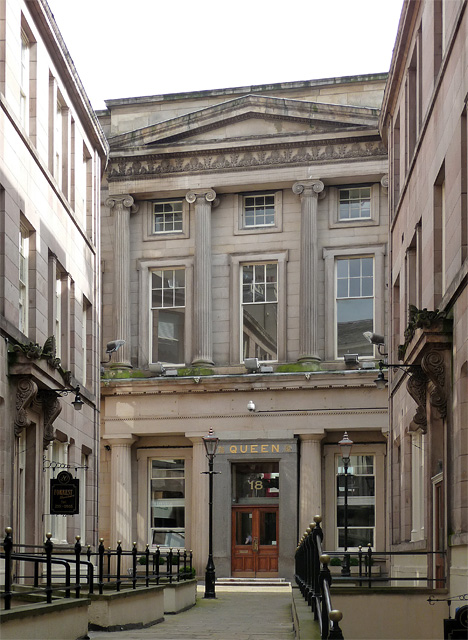
Queens Avenue Often called Liverpool's last Victorian arcade, this stone-paved passage keeps one twist: it never had a glass roof and stays open to the sky. You enter through arched openings off Castle Street and follow it through to Dale Street in the heart of the city.
Grand Victorian commercial buildings line the way, among them the Queen Insurance Building of the 1880s and the older Royal Insurance Building of 1839. Written either Queen or Queens Avenue, it now holds bars, a cafe, a gallery and offices, and occasional markets fill it too.
Watch for the arches, or you will walk straight past.
The Bluecoat
Photo: John S Turner via Geograph.org.uk
The Bluecoat A short stroll away on School Lane, the Bluecoat is an early Georgian brick building put up in 1716 and 1717, the oldest surviving building in the city centre. Raised as a charity school, which stayed until 1906, it later became a home for artists and, from the 1920s, an arts society; after a major restoration in the 2000s it now works as a contemporary arts centre around a garden courtyard.
Inside are galleries, artists' studios, a performance space, a cafe and independent shops, with free exhibitions and events. It is a Grade I listed building and a calm pause in the city.
St. Luke's Bombed Out Church
Photo: Eric Jones via Geograph.org.uk
St. Luke's Bombed Out Church Crowning the top of Bold Street in Liverpool, where Berry Street and Leece Street meet, stands the roofless Anglican shell that everyone knows as the Bombed Out Church.
It went up in Gothic style under the Foster family between 1811 and 1832, then an incendiary bomb tore through it during the May Blitz of 1941. The city chose to keep the gutted walls as a war memorial rather than rebuild.
Tower and masonry now stand open to the weather inside a public garden that hosts theatre, music, screenings, markets and a garden bar, a memorial to the Irish Famine set among them. It is a listed building.
Birkenhead Park
Photo: Stephen Richards via Geograph.org.uk
Birkenhead Park Just a few miles over the Mersey on the Wirral, Birkenhead Park is a large Victorian public park laid out in the 1840s and often held up as the first of its kind, a green space built with public money for ordinary people. It opened in 1847 to a design by Joseph Paxton, arranged not as formal gardens but as a rolling, natural-looking landscape of meadows, winding paths, woodland and two ornamental lakes.
Look out for a pretty covered Swiss bridge over the water, a lakeside boathouse and a grand columned entrance. Its ideas travelled far: designer Frederick Law Olmsted visited in 1850 and carried them home to help shape New York's Central Park.
Meols Beach
Photo: Colin Park via Geograph.org.uk
Meols Beach Around seven miles from the city on the north coast of the Wirral, Meols Beach runs between Hoylake and Wallasey, facing out over Liverpool Bay and the Irish Sea. A band of shingle at high tide gives way to a wide spread of sand and mudflats when the sea draws back, backed by the promenade of the North Wirral Coastal Park.
It is a breezy, open beach used for kite buggying, sand yachting and winter birdwatching, with sunsets over the water. The place has a long past: erosion here has turned up thousands of objects, from Roman brooches to Viking weapons, marking it as lived-in since ancient times.
Thurstaston Beach
Photo: Raymond Knapman via Geograph.org.uk
Thurstaston Beach A little further round, some eight miles out, Thurstaston Beach sits on the eastern shore of the Dee estuary, backed by crumbling cliffs of red sandstone and boulder clay, with wide views across the water to the hills of North Wales. It forms part of Wirral Country Park, whose clifftop visitor centre has a cafe, bird hides and picnic areas, and it lies about halfway along the Wirral Way, a walking and cycling trail on an old railway line.
The foreshore is muddy and sandy, better for walks and birdwatching than for bathing, with the tide reaching the cliffs at high water. There are no lifeguards.
Caldy Beach
Photo: Eirian Evans via Geograph.org.uk
Caldy Beach Close to West Kirby, roughly eight miles from the city, Caldy Beach is a quiet stretch of shore on the wide Dee estuary, reached by a path down through the village of Caldy. Much less busy than the larger sands nearby, it keeps a calm, out-of-the-way feel.
At low tide the estuary opens into a vast expanse of sand and mudflats stretching toward the hills of North Wales, while behind the beach rise the wooded sandstone slopes of Caldy Hill. It is a place for an unhurried walk with big estuary views, watching the birds on the flats and the light shifting over the water.
The tide comes in a long way.
Castell y Fflint
Photo: Eirian Evans via Geograph.org.uk
Castell y Fflint was where Edward I began, in 1277, the ring of castles that would seal his conquest of Wales. Flint Castle rises on a low mound beside the tidal Dee estuary at the edge of Flint town, its square plan set with a tower at each corner.
Most unusual is the great round tower at one of them, moated off from the rest of the castle so that it stands like a small fort in its own right. The remaining three towers and the curtain walls between survive only as ruin, open to the estuary wind and the incoming tide.
FAQs
Which beaches are near Liverpool?
The Wirral coast, just across the Mersey, holds several. Meols Beach faces Liverpool Bay between Hoylake and Wallasey, while Thurstaston and Caldy sit on the Dee estuary with wide views to North Wales, all within about eight miles of the city.
Can you visit a castle near Liverpool?
Yes. Flint Castle stands just over the Welsh border, about twelve miles from Liverpool on the tidal Dee estuary. Begun in 1277, it was the first of the castles Edward I built during his conquest of Wales.
How did Birkenhead Park influence Central Park?
Birkenhead Park on the Wirral, laid out in the 1840s as one of the first public parks, was visited by the designer Frederick Law Olmsted in 1850, who took its ideas home to help shape New York's Central Park.
Conclusion
From Georgian arcades in the centre to a Welsh castle beside the Dee, this eight brings together a genuine mix of days out. Start in the city with the Victorian passage of Queens Avenue, the arts-filled Bluecoat and the open-air shell of St Luke's.
Cross the Mersey for Birkenhead Park, the trailblazing Victorian green that helped inspire Central Park, then follow the Wirral coast to the breezy sands of Meols, the estuary views at Thurstaston and the quiet flats of Caldy. Finish over the border at Flint Castle, the first of Edward I's Welsh strongholds.
Arcades, gardens, coast and a medieval keep, all within easy reach: these are the places to visit near Liverpool.