Hidden Gems Near Liverpool

Written by UK Hidden Gems Editorial
Updated 5 August 2026
The hidden gems near Liverpool are Queens Avenue, The Bluecoat, St. Luke's Bombed Out Church, The Pen Factory, Williamson Tunnels, Birkenhead Park, Sefton Park Palm House and Sudley House.
Liverpool is a city of grand waterfront buildings, Georgian streets and a cultural life that spills out well beyond the Albert Dock. Look past the well-known sights and you find corners full of character, some hidden in plain sight in the centre.
Off Castle Street, Queens Avenue keeps its Victorian arcade air, while The Bluecoat, the oldest building in the city centre, shelters artists around a courtyard garden. Up on Bold Street, the roofless shell of St.
Luke's Bombed Out Church stands as a war memorial, and along Hope Street The Pen Factory pours cask ale by the Everyman. Eastward in Edge Hill lie the mysterious Williamson Tunnels, cut deep into the sandstone.
Further out there is greenery and grandeur: Birkenhead Park across the water on the Wirral, the tropical glasshouse of Sefton Park Palm House, and the paintings of Sudley House in Mossley Hill. Here are eight hidden gems to seek out near Liverpool.
Queens Avenue
Photo: Stephen Richards via Geograph.org.uk
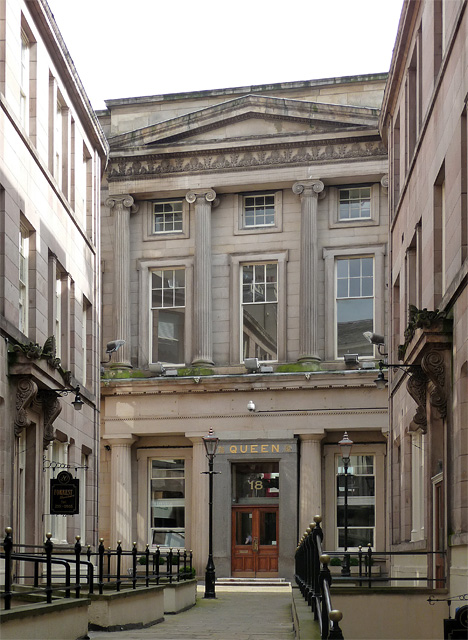
Queens Avenue Often described as Liverpool's last Victorian arcade, this stone-paved passage keeps one surprise: it is open to the sky rather than roofed in glass. You reach it through arched openings off Castle Street, and it runs through to Dale Street in the heart of the city.
Grand Victorian commercial buildings line the way, among them the Queen Insurance Building of the 1880s and the older Royal Insurance Building of 1839. Written variously as Queen or Queens Avenue, it now holds bars, a cafe, a gallery and offices, and occasional markets fill it too.
Slip through the arches and you are a step from the business district.
The Bluecoat
Photo: John S Turner via Geograph.org.uk
The Bluecoat For its first two centuries this was a charity school, teaching children from 1717 right up until 1906. The brickwork itself is older still, laid in 1716 and 1717, which makes it the oldest surviving building in Liverpool city centre and an early Georgian survivor on School Lane.
Artists moved in next, and an arts society took over from the 1920s; a major restoration during the 2000s reshaped it as a contemporary arts centre gathered around a garden courtyard. Now it holds artists' studios and galleries, a performance space, independent shops and a cafe, with free exhibitions and events all year.
It carries Grade I listing.
St. Luke's Bombed Out Church
Photo: Eric Jones via Geograph.org.uk
St. Luke's Bombed Out Church widely known as the Bombed Out Church, is the roofless shell of an Anglican church crowning the top of Bold Street in Liverpool, at the corner of Berry Street and Leece Street.
The Foster family built it in the Gothic style between 1811 and 1832, only for an incendiary bomb to gut it during the May Blitz of 1941, after which it was preserved as a war memorial rather than restored. Its surviving tower and walls now stand open to the sky within a public garden that hosts theatre, music, film screenings, markets and a garden bar, with a memorial to the Irish Famine in the grounds.
This listed landmark rewards a wander.
The Pen Factory
Photo: John S Turner via Geograph.org.uk
The Pen Factory is a bar and bistro on Hope Street, next to the Everyman Theatre and near the Metropolitan Cathedral, in a building that once housed a pen-nib maker, the Lang Pen Company, which gives it its name. It serves cask and craft beer, wine, cocktails and British-leaning food, including Scouse, with a beer garden at the back.
It opened in 2014 and has become a popular spot before or after the theatre, a short walk uphill from the centre of Liverpool.
Williamson Tunnels
Photo: Ruth Riddle via Geograph.org.uk
Williamson Tunnels form a maze of underground brick and stone chambers hewn into the sandstone below the Edge Hill district of Liverpool, dug in the early nineteenth century at the behest of Joseph Williamson, a wealthy tobacco merchant. Just why he ordered them remains a puzzle: perhaps to give work to the poor, perhaps to quarry sandstone that was then vaulted over.
A heritage centre off Mason Street leads guided tours through the excavated chambers and displays objects recovered from the infill, while a separate group of volunteers opens up further stretches. Book a tour to explore this curious buried world for yourself.
Birkenhead Park
Photo: Stephen Richards via Geograph.org.uk
Birkenhead Park is a large Victorian public park on Merseyside, laid out in the 1840s and often held up as the first of its kind, a green space built with public money for ordinary people to enjoy. It opened in 1847 to a design by Joseph Paxton, who arranged it as a rolling, natural-looking landscape of meadows, winding paths, woodland and two ornamental lakes, with a pretty covered Swiss bridge, a lakeside boathouse and a grand columned entrance.
Across the water on the Wirral, it is known well beyond Merseyside because it helped inspire New York's Central Park, after the designer Frederick Law Olmsted visited in 1850 and carried its ideas home.
Sefton Park Palm House
Photo: El Pollock via Geograph.org.uk
Sefton Park Palm House stands at the centre of Sefton Park in Liverpool, an octagonal Victorian glasshouse of iron and glass raised on a granite base and first opened in 1896, its cost met by the philanthropist Henry Yates Thompson. Step inside, free of charge, and you find palms, cycads, ferns and other tropical and subtropical plants growing among statues.
The building slid into disrepair and closed during the 1980s before a restoration brought it back in 2001, and these days it doubles as a setting for concerts, exhibitions and weddings. It is a lovely place to escape the weather for an hour.
Sudley House
Photo: Sue Adair via Geograph.org.uk
Sudley House is a Victorian merchant's villa in the Mossley Hill district of Liverpool that still houses the art collection of the shipowner George Holt, who made it his home from 1884. His daughter bequeathed both house and paintings to the city in 1944, and National Museums Liverpool now runs it, free to enter.
Inside, period-furnished rooms are hung with works by Turner, Gainsborough, Reynolds, Landseer and the Pre-Raphaelites, making it one of the few Victorian merchant collections still displayed in the very house it was assembled for. Gardens surround the villa.
Set aside a leisurely hour for the pictures and the grounds alike.
FAQs
Which hidden gems near Liverpool are free to visit?
Plenty are. The Bluecoat on School Lane runs free exhibitions, the Sefton Park Palm House is free to enter, and Sudley House in Mossley Hill, run by National Museums Liverpool, costs nothing to explore.
Can you visit the Williamson Tunnels in Liverpool?
Yes. The Williamson Tunnels beneath Edge Hill are open through a heritage centre off Mason Street, which runs guided tours of the excavated chambers, while a separate volunteer group opens further sections of this strange underground network.
What is the link between Birkenhead Park and Central Park?
Birkenhead Park, across the water from Liverpool on the Wirral, opened in 1847 as one of the first publicly funded parks. The American designer Frederick Law Olmsted visited in 1850 and carried its ideas home, where they helped inspire New York's Central Park.
Conclusion
Liverpool keeps its surprises close, whether you are wandering the arched passage of Queens Avenue or the courtyard of The Bluecoat in the heart of the city. Pause at the roofless St.
Luke's Bombed Out Church, raise a glass at The Pen Factory on Hope Street, or venture underground into the puzzling Williamson Tunnels at Edge Hill. Beyond the centre, Birkenhead Park across the water helped shape New York's Central Park, the Sefton Park Palm House shelters its tropical greenery, and Sudley House hangs its Turners in Mossley Hill.
Some are steps from the waterfront, others a short drive or a hop across the Mersey, but each shows a different face of the city. For art, history or a green escape, these are the hidden gems to seek out near Liverpool.