Top Hidden Gems Day Trips from Liverpool

Written by UK Hidden Gems Editorial
Updated 5 August 2026
The top Hidden Gems Day Trips from Liverpool include Queens Avenue, The Bluecoat, St. Luke's Bombed Out Church, The Pen Factory, Williamson Tunnels, Sefton Park Palm House, Sudley House and Crosby Beach.
Liverpool wears its history with real swagger, and beyond the waterfront there is a city full of quieter surprises. In the centre you can slip down Queens Avenue, a Victorian passage off Castle Street, then find the Georgian Bluecoat tucked behind School Lane.
A short walk uphill leads to St Luke's Bombed Out Church at the top of Bold Street, and along Hope Street the Pen Factory pours pints beside the Everyman. Head out to the Edge Hill district and you can venture into the mysterious Williamson Tunnels beneath the streets.
Further south, Sefton Park shelters its lovely Palm House, while nearby Mossley Hill holds Sudley House and its Victorian art collection. For a breath of sea air, drive north to Crosby Beach, where Antony Gormley's iron figures gaze out across the sand.
Whether you prefer galleries, gardens, curious corners or coastline, there is more than enough to fill a day. Here are eight hidden gems for a day trip from Liverpool.
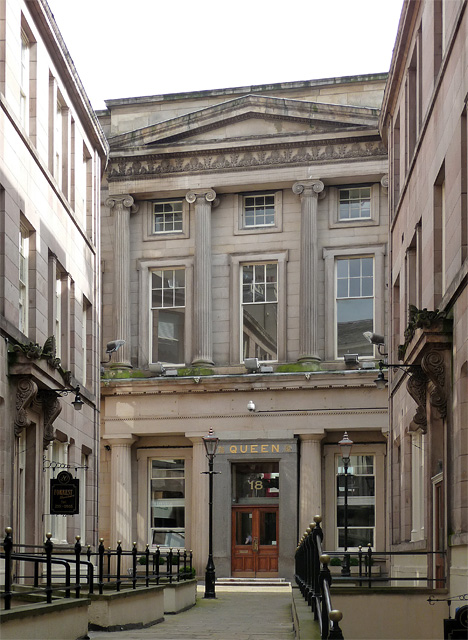
Queens Avenue
Photo: Stephen Richards via Geograph.org.uk
Wander Queens Avenue Often written Queens Avenue, this Victorian pedestrian passage runs between Castle Street and Dale Street in central Liverpool, entered through arched openings off Castle Street. Stone-paved and framed by grand Victorian commercial buildings, among them the Queen Insurance Building of the 1880s and the older Royal Insurance Building of 1839, it is often described as the city's last Victorian arcade, though it stays open to the sky rather than roofed with glass.
These days the passage holds bars, a cafe, a gallery and offices, and it hosts the occasional market too. It makes an easy, atmospheric detour just off the main streets.
The Bluecoat
Photo: John S Turner via Geograph.org.uk
Step inside the Bluecoat An early Georgian brick building on School Lane, the Bluecoat went up in 1716 and 1717 and is the oldest surviving building in Liverpool's city centre. It began life as a charity school, which stayed until 1906, before becoming a home for artists and, from the 1920s, an arts society.
After a major restoration in the 2000s, it now works as a contemporary arts centre set around a garden courtyard. You will find galleries, artists' studios, a performance space, a cafe and independent shops, with free exhibitions and events throughout the year.
Graded I listed, it is a calm, creative pocket in the heart of the city.
St. Luke's Bombed Out Church
Photo: Eric Jones via Geograph.org.uk
See St. Luke's Bombed Out Church Known to locals as the Bombed Out Church, St Luke's is the roofless shell of an Anglican church at the top of Bold Street, on the corner of Berry Street and Leece Street.
Built between 1811 and 1832 in the Gothic style by the Foster family, it was gutted by an incendiary bomb during the May Blitz of 1941 and kept as a war memorial rather than rebuilt. Today its tower and walls stand open to the sky within a public garden, hosting theatre, music, film screenings, markets and a garden bar.
A memorial to the Irish Famine sits in the grounds, and the building is listed.
The Pen Factory
Photo: John S Turner via Geograph.org.uk
Relax at the Pen Factory The Pen Factory is a relaxed bar and bistro on Hope Street, sitting next to the Everyman Theatre and close to the Metropolitan Cathedral. Its home once housed a pen-nib maker, the Lang Pen Company, which is where the name comes from.
Inside you can order cask and craft beer, wine and cocktails, along with British-leaning food that includes a hearty bowl of Scouse, and there is a beer garden tucked away at the back. It opened in 2014 and has become a well-liked spot for a drink or a bite before or after a show at the theatre next door.
Williamson Tunnels
Photo: Ruth Riddle via Geograph.org.uk
Venture into the Williamson Tunnels Cut into the sandstone beneath the Edge Hill district, the Williamson Tunnels form a network of underground brick and stone chambers, dug in the early 19th century under the direction of Joseph Williamson, a wealthy tobacco merchant. Quite why he had them made remains a mystery: some think he was providing work for the poor, others that he was quarrying sandstone that was then vaulted over.
A heritage centre off Mason Street runs guided tours through excavated chambers and shows objects dug from the infill, while a separate group of volunteers opens up further sections. It is an intriguing, slightly eerie corner of Liverpool.
Sefton Park Palm House
Photo: El Pollock via Geograph.org.uk
Visit Sefton Park Palm House This octagonal Victorian glasshouse of iron and glass sits on a granite base in the middle of Sefton Park, a few miles south of central Liverpool. Opened in 1896 and paid for by the philanthropist Henry Yates Thompson, it is free to enter, and inside grow palms, cycads, ferns and other tropical and subtropical plants dotted among statues.
Having fallen into disrepair and closed in the 1980s, it was carefully restored and reopened in 2001. These days it also doubles as a venue for concerts, exhibitions and weddings.
It makes a beautiful, green-fingered stop within one of the city's finest parks.
Sudley House
Photo: Sue Adair via Geograph.org.uk
Explore Sudley House A Victorian merchant's villa in the Mossley Hill area, Sudley House still holds the art collection of the shipowner George Holt, who lived here from 1884. His daughter left both house and pictures to Liverpool in 1944, and National Museums Liverpool now runs it, free to enter.
Wander through the period-furnished rooms and you will find paintings by Turner, Gainsborough, Reynolds, Landseer and the Pre-Raphaelites, one of the few Victorian merchant art collections still hanging in the house it was gathered for. Gardens wrap around the villa, making it a peaceful spot away from the bustle of the city centre.
Crosby Beach
Photo: Mike Faherty via Geograph.org.uk
Walk Crosby Beach A long stretch of tidal sand on the coast north of Liverpool, Crosby Beach is best known for Another Place, an installation by the sculptor Antony Gormley. A hundred life-size cast-iron figures, each modelled on the artist's own body, are spread along about two miles of foreshore, all facing out to sea, and the tide slowly covers and uncovers them, leaving them rusted and barnacled over the years.
The beach is open and free, with the figures scattered across the sand. Reachable on a short drive north from the city, it is worth noting the sand is soft and the tides fast, so the water is not for swimming.
FAQs
How far is Crosby Beach from Liverpool city centre?
Crosby Beach lies on the coast a little over ten kilometres north of central Liverpool, an easy drive or a ride on the Merseyrail line. It is the one spot on this list that calls for transport, with the rest clustered in and around the city.
Which of these Liverpool gems are free to visit?
Plenty cost nothing. The Bluecoat, Sefton Park Palm House and Sudley House are all free, as is a wander through St Luke's Bombed Out Church garden. The Williamson Tunnels charge for their guided tours beneath Edge Hill.
Can I see several of these in a single day?
Absolutely. The central Liverpool gems sit within walking distance of each other, so you could combine Queens Avenue, the Bluecoat, St Luke's and the Pen Factory easily, then add Sefton Park or Crosby if time allows.
Conclusion
From half-hidden passages to sea-swept sand, Liverpool and its surroundings offer a day trip with real variety. In the centre you can duck into Queens Avenue, explore the creative Bluecoat, and stand among the ruins of St Luke's before pausing for a pint at the Pen Factory.
Underground, the Williamson Tunnels add a dash of mystery, while the leafy south side holds the Palm House in Sefton Park and the paintings of Sudley House. When the city has been thoroughly enjoyed, a drive north brings you to Crosby Beach and Antony Gormley's watchful iron figures.
History, art, gardens and coast all lie within easy reach of one another. Pick a handful or attempt the lot, but either way, these are the hidden gems for a day trip from Liverpool.