Best Places to Visit Near Middlesbrough

Written by UK Hidden Gems Editorial
Updated 5 August 2026
The best places to visit near Middlesbrough are North Gare Beach, Heugh Breakwater, Steetley Pier, Blackhall Rocks Beach, Guibal Fanhouse, Horden Beach, Thomason Foss and Richmond Falls.
Middlesbrough sits where the River Tees meets the North Sea, and its coast and countryside pull in several directions at once. Head north along the shore and you reach a run of Durham beaches and landmarks: North Gare Beach at the mouth of the Tees, the Victorian Heugh Breakwater on the Headland at Hartlepool, the rusting skeleton of Steetley Pier just beyond, and the cave-pierced cliffs of Blackhall Rocks.
Further up the Durham Heritage Coast lies Horden Beach, a shore reborn after its mining past. Turn inland and east into the Cleveland hills for the Guibal Fanhouse, a rare relic of the old ironstone mines.
For two grander days out, drive south into the North York Moors, where Thomason Foss drops into a wooded plunge pool near Goathland, or southwest to Richmond, where Richmond Falls tumbles over ledges of the River Swale below the castle. It is a mix of sand, stone and falling water.
Here are eight places to visit near Middlesbrough.
North Gare Beach
Photo: Mick Garratt via Geograph.org.uk
North Gare Beach lies a short way north of Middlesbrough at the northern mouth of the River Tees, near Seaton Carew, a sandy shore backed by low dunes and a golf links within the Teesmouth nature reserve. Its landmark is the North Gare breakwater, an old training wall reaching out into the sea and crossed on foot over the dunes.
The outlook is one of sharp contrasts, wild coast and wildlife to the north, the chimneys and cranes of the Teesside works to the south. Birdwatchers love it for the waders and migrants along the tideline, and there is a car park close by.
Heugh Breakwater
Photo: Chris Morgan via Geograph.org.uk
The Heugh Breakwater reaches out to sea from the Headland at Hartlepool in County Durham, a long Victorian structure built in the 1850s from great blocks of concrete. It has taken a battering from the North Sea over the years, and part of the outer end is now fenced off as unsafe.
Close by stands the Heugh Lighthouse, its white tower one of a pair of markers set on the point. From the breakwater and the headland around it, the view opens over the harbour and out across the open water, making it a bracing, breezy spot for a coastal stroll north of Middlesbrough.
Steetley Pier
Photo: Andy Waddington via Geograph.org.uk
Steetley Pier is the skeletal, half-ruined remains of an old industrial jetty striding out into the North Sea on the beach north of Hartlepool in County Durham. It once drew seawater in for a magnesite works, a factory long since pulled down and its site built over, leaving only the rusting iron legs of the pier marching away from the shore.
Photographers seek it out, especially at sunrise and sunset, when the low light catches the ironwork and the water beyond. You reach it on foot from the seafront, with beach and dunes spreading around it, and it feels wonderfully forlorn.
Blackhall Rocks Beach
Photo: Kevin Waterhouse via Geograph.org.uk
Blackhall Rocks Beach is a rugged stretch of the Durham coast between Hartlepool and Seaham, set beneath cliffs of pale magnesian limestone. This is a rocky, pebbly shore rather than a broad sweep of sand, its cliffs pierced by some of the largest caves along the coast and worn into hollows and inlets by the sea.
Steep steps drop from the clifftop, where a nature reserve of thin, lime-rich grassland grows rare wildflowers into early summer, loud with skylarks. Coal waste once left the shore black, until a big restoration around 2000 brought it back to life.
Its bleak past even featured in the closing scene of the film Get Carter.
Guibal Fanhouse
Photo: habiloid via Geograph.org.uk
The Guibal Fanhouse is the stone shell of a building that once housed a great ventilating fan, its job to draw stale air up out of a mine's workings. The best-preserved example stands at the old Skelton ironstone mine in the Cleveland hills, east of Middlesbrough, a listed ruin of concrete and brick raised around 1870 for a fan some thirty feet across.
Its heavy walls now stand open to the sky on the hillside, a rare survival of the machinery that kept the miners' air fresh below ground. It is a quiet reminder of the ironstone mining that once worked all through these hills.
Horden Beach
Photo: Carol Rose via Geograph.org.uk
Horden Beach is a long shore on the Durham Heritage Coast that once ranked among the most polluted beaches in Europe, when coal waste poured onto it from the pits above. A major clean-up around 2000 stripped away the spoil, and the sand has recovered far faster than anyone expected, though it still carries a stain of ochre and coal in places.
Low limestone cliffs rise behind, topped by grassland, with the coast railway running along the clifftop. It stays a quiet beach with few facilities, which is much of its appeal, and it makes a peaceful stop on a longer coastal wander north of the town.
Thomason Foss
Photo: steven ruffles via Geograph.org.uk
Thomason Foss is worth a day-trip south into the North York Moors, near Beck Hole and Goathland, where Eller Beck drops through a wooded, rocky ravine. The beck tips into a dark, enclosed plunge pool that has become a well-liked wild swimming spot, reached on a walk of about twenty minutes from the bridge by the Beck Hole pub, following the water upstream and scrambling over boulders at the end.
It is a quieter, smaller fall than nearby Mallyan Spout, hidden away in the trees, and it runs fuller and louder after a spell of rain, so time your visit accordingly.
Richmond Falls
Photo: Gareth James via Geograph.org.uk
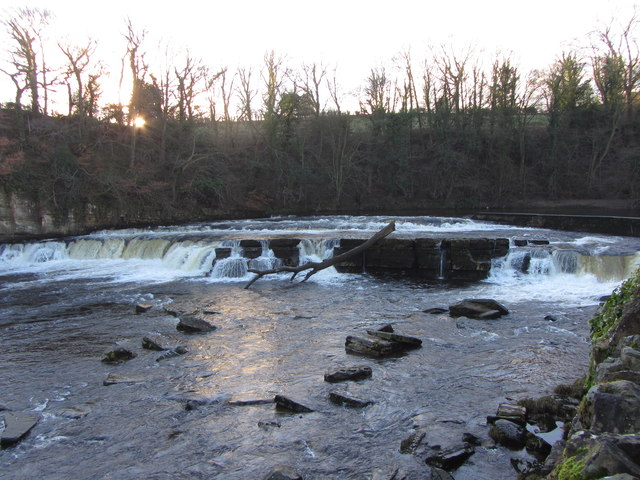
Richmond Falls rewards a drive southwest to the town of Richmond in North Yorkshire, where a series of natural waterfalls tumbles over the River Swale right in the middle of town, just below the castle on its rock. The river spills across stepped ledges, gentle in dry weather but a powerful, roaring cascade after heavy rain, with riverside paths running along both banks.
There is parking, there are toilets and a play area close by, and a viewpoint over the falls sits near the car park. That makes it an easy, family-friendly stop in the heart of a handsome market town.
FAQs
Which beaches are near Middlesbrough?
Several beaches lie north of Middlesbrough along the Durham coast, including North Gare Beach at the mouth of the Tees, the cave-pierced Blackhall Rocks and the reborn sands of Horden Beach.
How far is Richmond Falls from Middlesbrough?
Richmond Falls sits around 38 kilometres southwest of Middlesbrough, in the town of Richmond, so it works best as a day-trip. You will find parking, toilets and a viewpoint over the falls close by.
Are there good spots for wild swimming near Middlesbrough?
Thomason Foss, in the North York Moors near Goathland, is a well-liked wild swimming spot south of Middlesbrough, with a dark plunge pool reached on a twenty-minute walk from Beck Hole.
Conclusion
Few towns offer such a spread of coast and country as Middlesbrough. Follow the shore north and you pass North Gare Beach, the Heugh Breakwater and the haunting ironwork of Steetley Pier, then the cave-cut cliffs of Blackhall Rocks and the reborn sands of Horden Beach.
Turn east into the Cleveland hills and the Guibal Fanhouse recalls the ironstone mines that once shaped the land. Save a full day for the North York Moors, where Thomason Foss hides in its wooded ravine, or for Richmond, where Richmond Falls thunders below the castle.
From breakwaters and beaches to plunge pools and cascades, these are the places to visit near Middlesbrough.